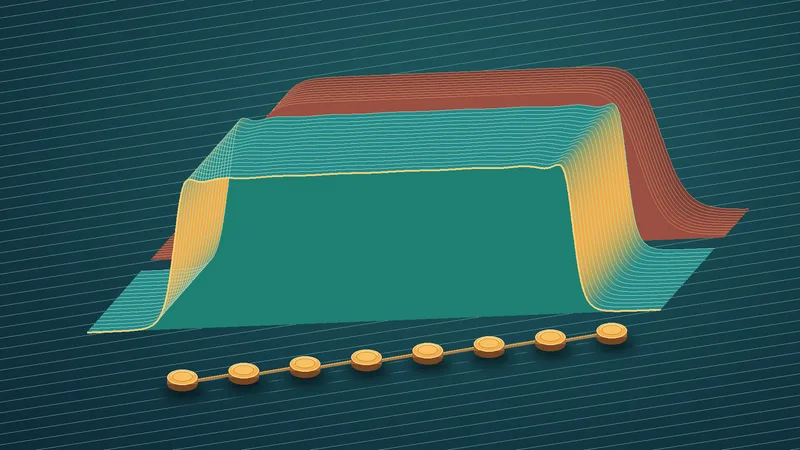
As noninteracting fermion chains grow longer, their best dissipation–precision measure can fall nearly as the inverse square of their length. A new theoretical proof explains the limits of this improvement—and reveals the price the contacts must pay to maintain the flow.
The vertices keep their directions, yet the edges encountered along each ray can all appear in reverse order. A geometric proof explains why such a straight-edged mesh can always be redrawn this way.
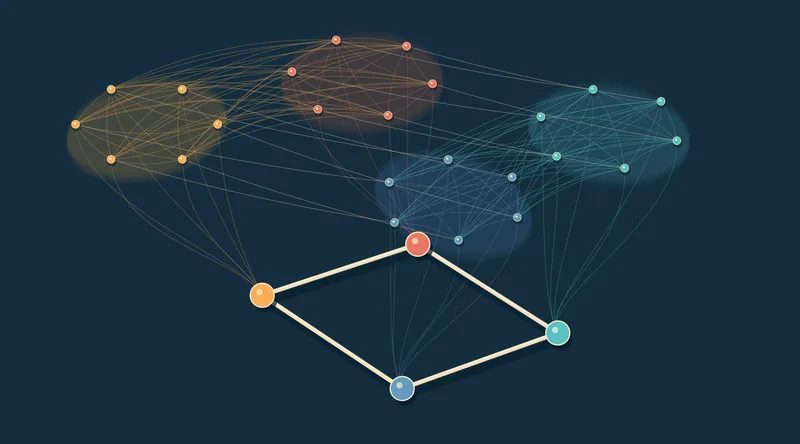
Grouping tightly connected vertices and contracting each group may reveal a structure close to a tree. A researcher at Gewu has proved that deciding whether such a grouping exists remains NP-complete even when the skeleton has no triangles and treewidth at most two.
For the reconstruction of an unknown quantum state to outperform classical methods, the classical information sent in one direction must exceed a lower bound. A new proof shows that changing the measurement or recovery operations cannot lower it.
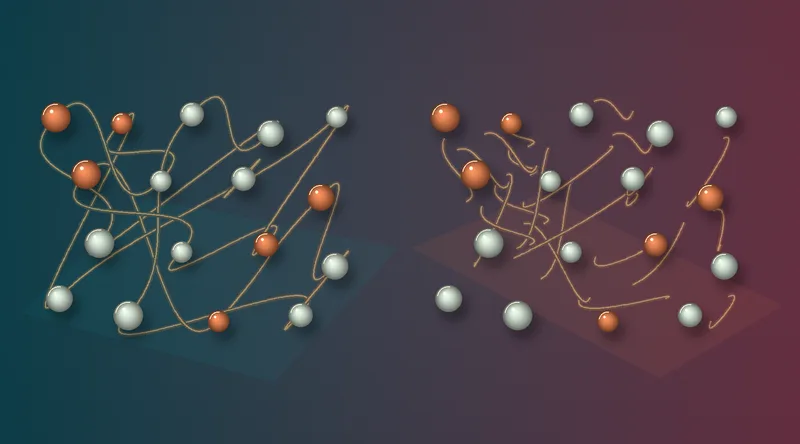
In a dilute hard-sphere model, collective correlations left by collisions link entropy increase to the false-positive probability of a time-reversal test; finite readouts can retain nearly all the ability to distinguish the two preparations.
In a class of idealized models, Gewu researchers prove that even rearranging every neuron cannot eliminate the limits that fine spatial resolution places on discrimination speed.
As long as additional interactions remain unchanged under a uniform twist, a class of spin rings has an energy gap that cannot exceed the bound set by nearest-neighbor exchange itself, however strong or far-reaching those interactions may be.
In a 64-point model, increasing the connection scale by one step makes all sixteen three-dimensional holes disappear, while a new hole appears. This refutes the idea that the number of surviving features can be determined solely from the hole counts at the two scales.
A family of algebraic objects defined by matroids shows that any collection missing one direction can deform jointly, yet all directions together may encounter an obstruction at any prescribed order.
Using a precisely defined uniform sampling scheme, Gewu researchers have calculated the exact probability and proved that, when two measurements are sufficiently biased toward an outcome, they can always be implemented by a single joint measurement.
An orthogonal measurement is enough when the sole goal is to maximize information or minimize errors. Researchers at Gewu have proved that the optimal trade-off between the two can require a more general measurement.
For a class of multipartite entangled states, Gewu researchers have calculated the minimum measurement dependence needed to reproduce all measurement outcomes, and found that the same Bell violation can entail different costs.