
As we gradually relax the rules for connecting a set of points, what happens to the holes they enclose? If there are sixteen holes to begin with and one at the next step, it is tempting to assume that at least one old hole has survived. Researchers at Gewu have proved that things can turn out quite differently on a square grid with opposite edges joined: all sixteen old holes disappear, and a new hole appears at precisely the same step. To understand this seemingly ordinary change in numbers, the key is not to count holes but to identify whether the holes at one scale persist into the next.
Why counting holes is not enough
Suppose you have just a ring of scattered points. How can you tell that they trace out a loop? One approach is to set a distance threshold and connect points that are close enough. If the threshold is too small, the points remain isolated; relax it a little, and the connections may form a closed loop; relax it further, and the interior of the loop may be filled in. A shape at a single threshold tells us little about which structures survive changes in scale.
Persistent homology, a tool in topological data analysis, studies precisely this persistence. It records the scale at which a hole of a given kind appears and the scale at which it is filled in, and it tracks whether a structure at one scale still exists at a later one. What changes here is the scale at which we observe and connect the points; the points themselves do not move.
Counting holes and tracking them are, of course, different tasks. But in some especially regular models, could one happen to substitute for the other? In 2025, Henry Adams, Adenike Yeside Adetowubo, Hector Barriga-Acosta, Ziqin Feng and John Sterling studied a family of periodic square grids and posed a specific question: for their three-dimensional holes, does the independent information that survives across scales always attain the maximum allowed by the hole counts before and after the change? Question 8.9 in their paper presents this idea.
This would offer an appealing simplification. Suppose there are sixteen independent holes at the earlier scale and only one at the later scale. At most one independent old hole can survive. If this property of “preserving as much as possible” holds, knowing the hole count at each scale would let us infer how much information survives between any two scales, without tracking the relationships between them.
The counterexample provided by Gewu’s researchers is precisely a case of sixteen becoming one: the number that actually survives is zero. To understand how this is possible, we first need to see how this grid gives rise to holes.
How can points in a plane have three-dimensional holes?
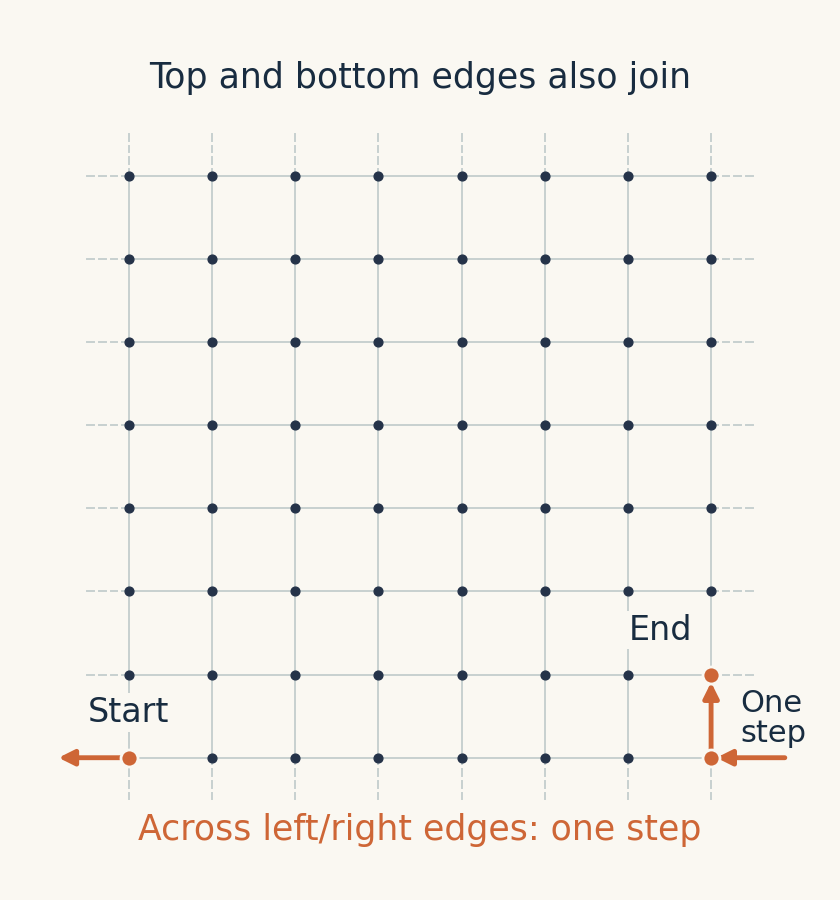
Imagine a square grid of eight rows and eight columns, containing 64 points. Step beyond the right edge, and you return from the left; step beyond the top, and you return from the bottom. Joining opposite edges in this way gives a torus. Two points on opposite edges that look far apart on paper may actually be neighbors.
The distance between two points is the minimum number of horizontal and vertical steps needed to get from one to the other, allowing paths to wrap around across the boundaries. It is not the straight-line distance on the page. For example, it takes only two steps to get from the bottom-left point to the point on the far right one row up: first step left across the boundary, then step up.
Next, choose a scale—a distance threshold. If the distance between two points is no greater than the threshold, add an edge. If all three pairs among three points satisfy the condition, fill in the triangular face between them as well. If every pair among four points satisfies it, fill in the entire tetrahedron. Apply the same rule to larger sets of points, adding the corresponding solid simplices in higher dimensions. A simplex generalizes line segments, triangles and tetrahedra to higher dimensions. The entire structure is called a Vietoris–Rips complex, or a Rips complex for short.
Crucially, we are adding more than just lines. The three edges of a triangle can enclose a one-dimensional hole; filling in the triangular face makes that hole disappear. Many triangular faces can form a closed, hollow spherical shell, a two-dimensional closed structure. If a solid region within the complex already fills it, it no longer represents a two-dimensional hole. Extending the same rule to higher dimensions gives a three-dimensional hole: a three-dimensional structure with no boundary that cannot be filled by four-dimensional parts of the complex.
Here, the mathematical “dimension” is that of the closed structure enclosing the hole. An ordinary hollow spherical shell therefore corresponds to a two-dimensional hole, while the three-dimensional holes in this article are one dimension higher. They are not the visible hole in the middle of a doughnut.
How can a two-dimensional grid produce such a structure? The grid supplies only the points and their distances. The dimension of the newly constructed complex is determined by which points are pairwise close enough, and is not limited by the dimension of the page. Drawing it in a plane makes many edges and faces overlap, but these crossings in the picture do not change its abstract connections.
Homology provides a rigorous way to count: closed structures that can be transformed into one another using fillings already present in the complex belong to the same class; those that can be filled by existing parts belong to the zero class. The number of independent classes that cannot be expressed as combinations of one another is called the Betti number in the corresponding dimension. From here on, we will call them “independent holes” for short. The numerical results use arithmetic modulo two: two occurrences of the same face or higher-dimensional simplex cancel each other out. This is the counting convention used for the paper’s counterexamples.
As the scale increases, all the old edges, faces and higher-dimensional parts remain, while new parts are continually added. Every old closed structure can therefore still be found in the new complex, but it may now be filled by new parts, or it may become equivalent to other old structures. The number of independent classes that actually persist is called the rank of the map between these scales. This is more precise than asking “how many old holes remain,” because the choice of independent classes is not unique.
Sixteen lifelines end at the same point
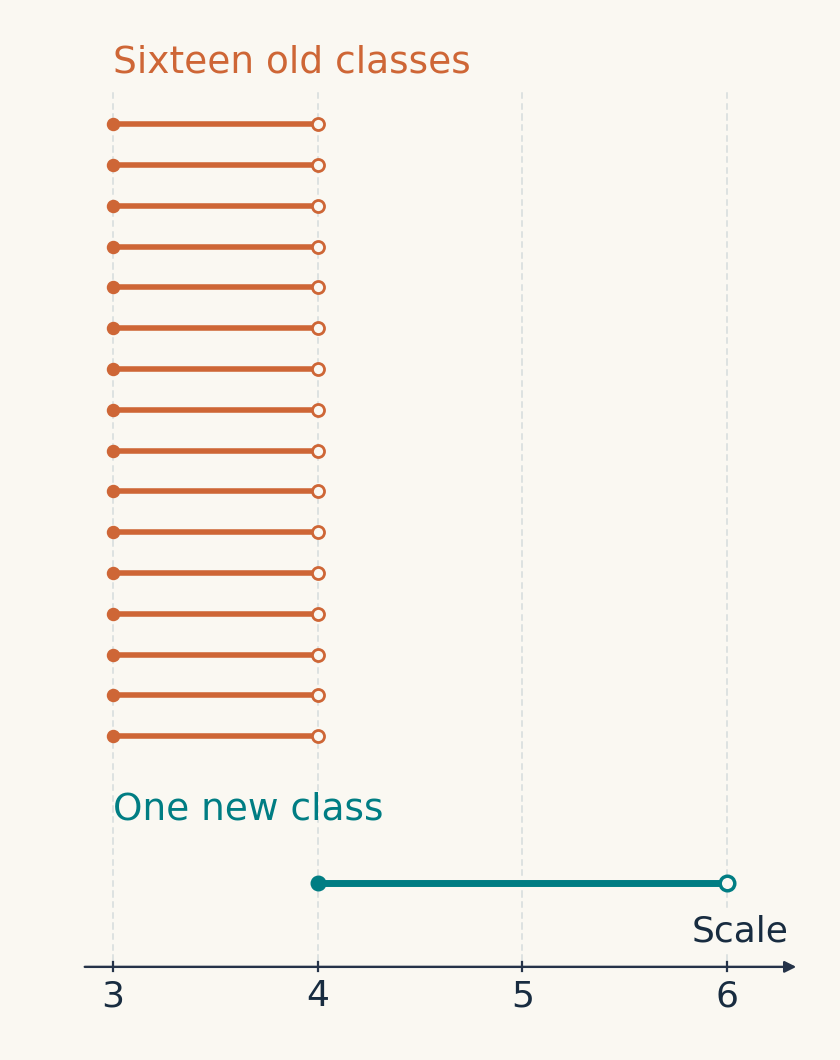
On this eight-by-eight periodic grid, increasing the scale from three steps to four lowers the third Betti number from sixteen to one. Gewu’s researchers proved that the map associated with this change has rank zero: all sixteen old independent classes, in any combination, can be filled at the new scale.
At the same time, there really is a nonzero three-dimensional class at scale four. It cannot be a continuation of any old class, so it must be newly born.
A barcode makes this clear. Each horizontal bar represents the interval of scales from an independent class’s birth to its death. Counting the bars that pass through a given scale gives the hole count at that scale. To find how much independent information survives from one scale to another, count the bars that cover both scales.
This result comes from more than a barcode. The paper checks the smallest counterexample through two computational approaches: one computes persistent homology; the other directly checks the matrix relationships between closed structures and fillings, using exact arithmetic modulo two, and also obtains rank zero. Gewu’s researchers also examined square torus grids with side lengths below eight, confirming that this is the smallest counterexample within this family of models. Here, “smallest” applies only to square torus grids, not to all point sets.
Numerical results, however, tell us only what happens. To explain why all the old holes must disappear, we need to find where they were hiding.
Finding all the old holes in eight rows and eight columns
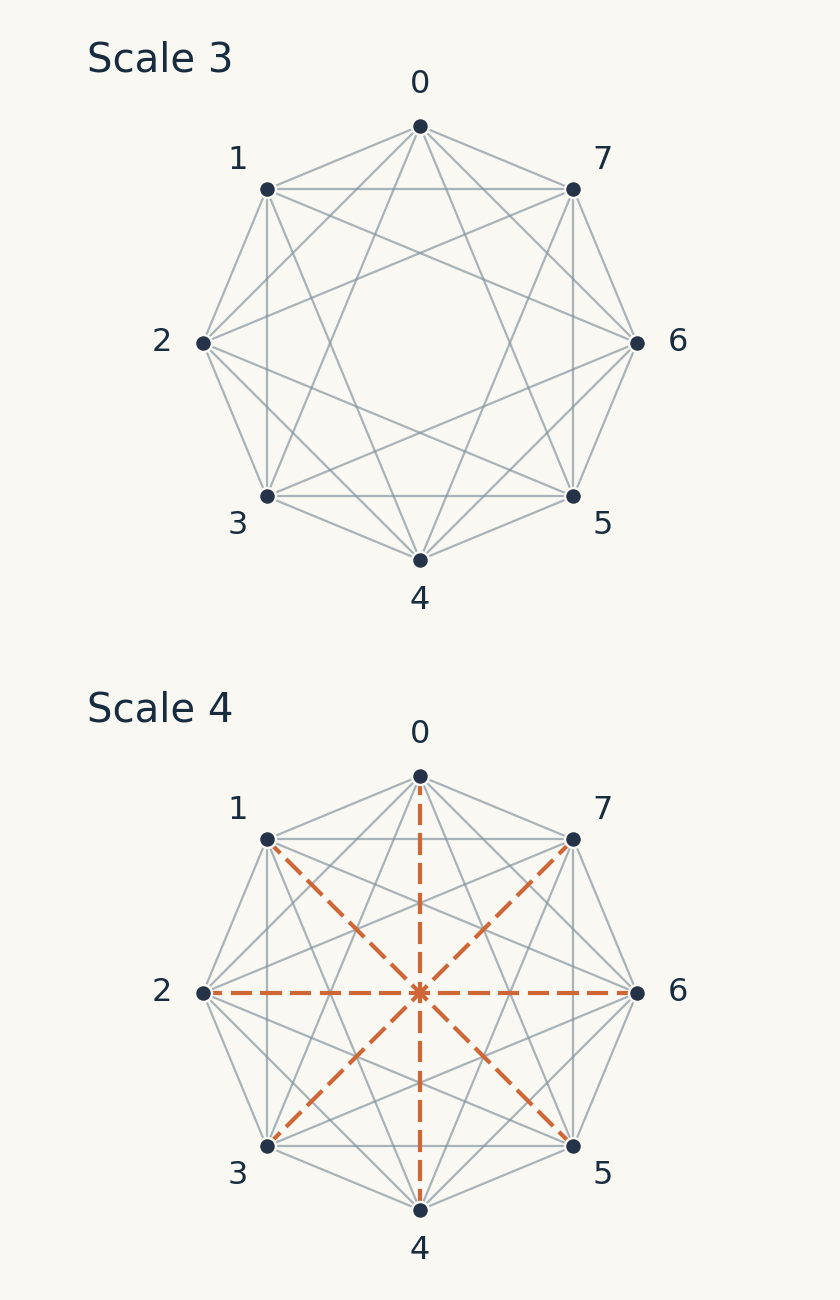
First, take just one row of the grid. Because its left and right ends join, it consists of eight evenly spaced points around a circle, with distance measured by the shortest number of steps around the circle. Construct a Rips complex for this row alone, using the same rule.
At scale three, each point connects to every other point except the one directly opposite. The circle may look one-dimensional, but once every set of pairwise connected points is filled in as a simplex, the resulting complex is homotopy equivalent to a three-dimensional sphere. Roughly speaking, homotopy equivalence means retaining the same topological structure after allowing continuous deformations and contractions. This complex contributes exactly one independent three-dimensional class.
This is not a matter of hollowing out the center of an ordinary circle. The structure is formed jointly by long-range connections and higher-dimensional fillings. Earlier mathematical theorems already classify such Rips complexes of circles.
Each of the eight rows has one such class, as does each of the eight columns. An earlier structure theorem had already given the hole count for the entire complex. Following its decomposition, Gewu’s researchers went further and identified the specific sources of these holes. The decomposition starts with a core that has no three-dimensional classes, then attaches the circular sections one at a time. The attaching regions have only the topology of points or circles, so the attachments neither create additional three-dimensional classes nor cancel any out. The classes in these sixteen specific sections are therefore independent in the entire complex, and their combinations span all its three-dimensional classes. The key word is “all”: no old class can be hiding outside the rows and columns and escape the next step of the analysis.
Now raise the scale to four. The shortest distance between any two points on the circle is no greater than four, so even opposite points become connected. Every subset of these eight points now meets the filling condition, and the entire complex becomes a solid seven-dimensional simplex. It can contract as a whole to a point, leaving no holes in any positive dimension.
Thus, each old class can be filled within its own row or column. These sections are all contained in the entire new complex, so fillings completed locally remain valid in the whole. Since the sixteen old classes exhaust all possible sources, filling them all means that the entire map is zero.
The newly born hole is different. No single row or column has any three-dimensional holes left, so it cannot come from a single circular section alone; it must involve the global structure formed by both directions of the grid together. The paper proves that this class exists and is newly born, but does not prove that the entire new complex can be deformed into a three-dimensional sphere. A hole count of one is not enough to establish that.
What survives on larger grids?
This is not a one-off coincidence involving 64 points. Let the grid have points on each side, and consider the change in scale from to , where is an integer at least three and is the number of points per side. All three-dimensional classes at scale are again carried by rows and columns, totaling .
The known classification of Rips complexes of circles says that when the ratio of the scale to the number of points on the circle lies strictly between one-third and two-fifths, the complex has the homotopy type of a three-dimensional sphere. The sections described above all lie in this range at the initial scale. For from three through seven, the ratio at the next scale reaches or passes two-fifths, and all the three-dimensional classes in the sections disappear. Thus, the same “death of every old class” occurs for the five side lengths eight, eleven, fourteen, seventeen and twenty. The paper’s computations modulo two also confirm that the target scale has exactly one three-dimensional class in each of these five cases, making all of them counterexamples.
Starting at , the next scale remains below two-fifths, and the situation changes: the three-dimensional classes in the sections persist. But they are no longer all independent in the entire grid.
The reason can be seen from the distances. Translate the same source section to an adjacent row, and the extra distance between the two corresponding structures is at most one step—exactly accommodated by the one-step increase in scale. For any simplex in the original section, all its vertices in both rows, taken together, can be filled in as a simplex at the new scale. This makes the classes represented by the two rows equal in the new complex. Comparing row after row, the images of all the rows merge into a single independent direction; the same holds for the columns.
The two directions from rows and columns do not merge with each other. Project the entire grid onto the horizontal coordinate circle and onto the vertical coordinate circle. One projection preserves the horizontal class while collapsing the vertical class to a point; the other does the reverse. These two tests distinguish them. Gewu’s researchers therefore proved that, for all , the map across this step has rank exactly two.
Whether rank two is already as large as possible depends on how many classes there are at the target scale. For and , previously published computations modulo two give a target hole count of three, yielding two more counterexamples. The paper cites those existing results for these two larger computations rather than rerunning them. For larger grids, the paper also studies new classes with rational coefficients, but these cannot directly supply the answer for coefficients modulo two. The paper does not establish a general rule for the target hole count modulo two.
The initial question thus has a clear answer: even when points are arranged so regularly, the hole counts before and after a change cannot substitute for the persistence relationships across scales. Sixteen becoming one can mean that the old structures disappear completely while a new structure appears; a larger number of old classes can also leave just two independent directions, horizontal and vertical. Persistent homology tracks precisely this history that a table of hole counts cannot show.
Research basis: the accompanying paper, “Non-maximal persistence in Vietoris–Rips complexes of torus grids” (August 25, 2026), particularly Sections 3–4, 6 and 8 and Appendix B. For the background question and the earlier structure theorem, see Adams and colleagues’ “Vietoris–Rips complexes of torus grids”. All illustrations were created for this article based on the paper. Figure 2 redraws the exact intervals reported in the paper; Figures 1 and 3 are schematic illustrations of the model, and the cover is a visual metaphor.