
Suppose a geometric object can change in three small ways. Each change is possible on its own, and any two can proceed together. Could combining all three still cause a problem? Gewu’s researchers have constructed an example in which the specified changes remain consistent through the first two orders but cannot continue to the third. Lengthening the cycle in the construction allows this delayed conflict to appear at any prescribed order. This exposes a limit of pairwise checks: even if every local combination passes, whether the whole works may still depend on higher-order interactions.

How equations change shapes
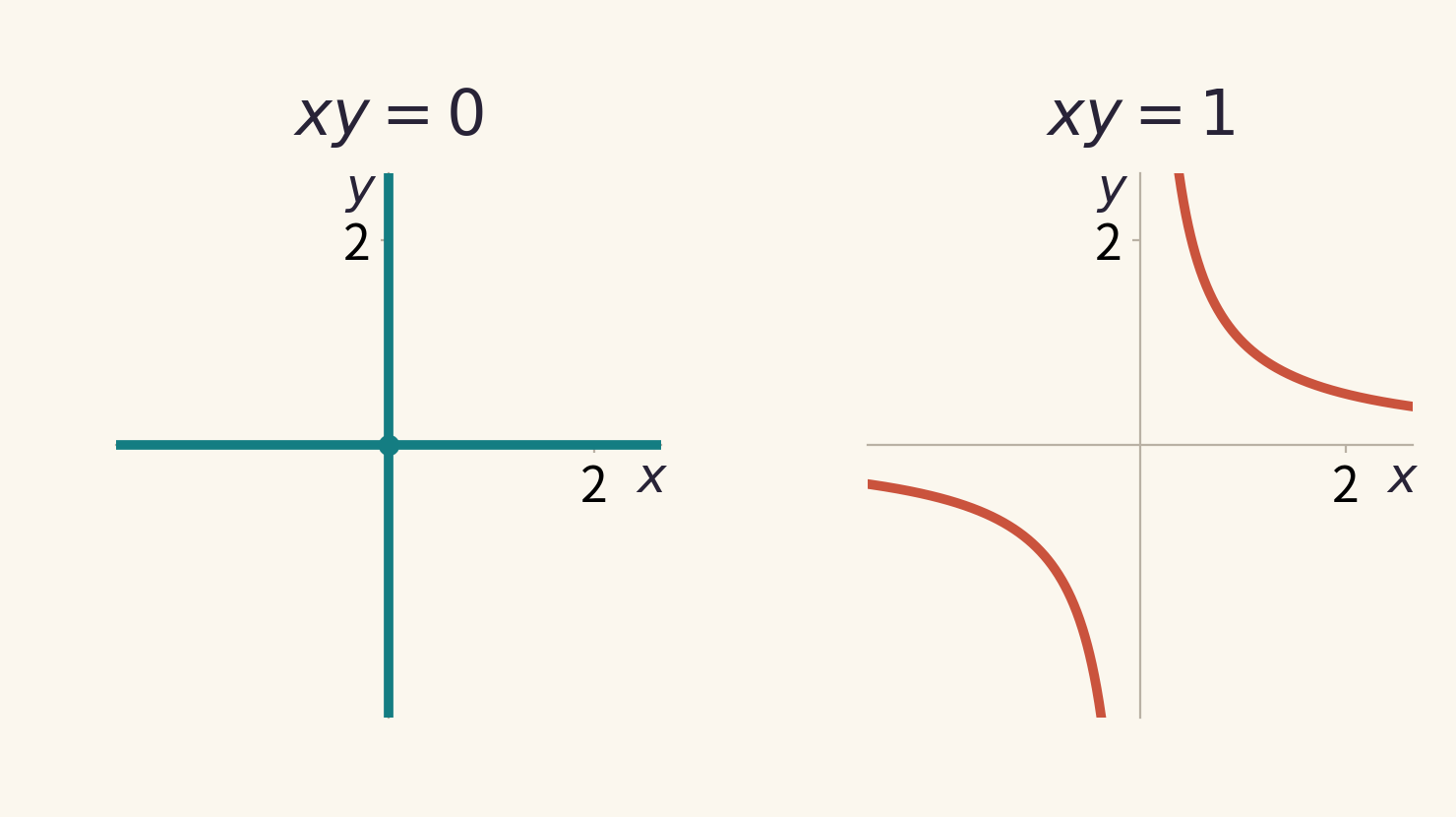
Draw the two coordinate axes in a plane. A single equation can describe them:
Here, and are the two coordinates of a point. A product of zero means that at least one coordinate is zero, so the solutions form exactly two intersecting lines. Now replace the zero on the right with a parameter . When is positive, the real solutions of form the two branches of a hyperbola, opening up the original intersection.
For algebraic geometers, changing equations is a way to study geometric objects: seemingly different shapes may be members of the same family of equations at different parameter values. To understand which shapes can be connected, one must first establish whether an initial change can actually be continued.
The difficulty is that an object is usually defined by many equations together. These equations are not independent: they already have relations that must be preserved. For example, suppose we require both and , where is a third coordinate. If we change only the first equation to and leave the second unchanged, multiplying the equations by the appropriate variables and comparing them gives . Whenever the parameter is nonzero, we are therefore forced to impose as well; an entire class of previously allowed points suddenly disappears.
Mathematicians use “flatness” to place a rigorous constraint on this behavior, ensuring that the change remains consistent in an algebraic sense, rather than resolving contradictions by quietly adding conditions. Flatness demands more than visually continuous change. Studying deformations requires more than writing down new equations: one must also prove that the relations among the original equations can continue along with them.
Usually, one can start with the smallest step. Expand the changes by degree in the parameters: a term containing one parameter factor is first order, a term containing two factors is second order, and so on. Here, “order” records how finely the expansion is resolved; it is neither time nor spatial dimension. Temporarily discarding terms of second order and higher asks only whether this direction of change is initially allowed. Keeping terms through second order lets us check the earliest interactions.
For example, if and control two different changes, a mixed term may appear at second order. If no second-order correction can eliminate the conflict while preserving the relations among the equations, this constitutes a quadratic obstruction. A standard tool for calculating such pairwise conflicts is called the “cup product.” All we need to remember here is what it does: it detects whether two first-order changes are compatible at the earliest mixed order.
If all cup products vanish, can we safely continue? The answer bears on how much deformation theory can be simplified. If second-order checks suffice, Gewu’s researchers need not keep adding higher-order terms indefinitely. If they do not, the important question is how deeply later obstructions can remain hidden.
From independent sets to geometry
The new paper studies this question in a class of algebraic objects generated by combinatorial rules. These rules come from “matroids,” mathematical structures that abstract the idea of independence.
Consider a road network. A selection of roads can be regarded as independent if it contains no cycle; once a road closes a cycle, it introduces redundancy. Matroids retain the rules that such independent sets share: every subset of an independent set remains independent, and a smaller independent set can always borrow an element from a larger independent set while remaining independent. The elements need not actually be roads: matroids can also describe dependencies among vectors or points.
Next, assign a variable to each element. For each minimal set at which dependence first appears, set the product of the corresponding variables equal to zero. These product equations define a geometric object. The algebraic structure that records its rules for polynomial operations is called a Stanley–Reisner ring. In this way, combinatorial rules become equations that can be deformed. It is these equations and their associated ring that change; the independent sets of the matroid itself form a discrete list and are not being continuously bent.
The paper’s smallest example of a higher-order obstruction has six elements, divided into two groups of three. Draw them on two parallel lines: the three points on the same line are dependent, while any three points drawn from both groups are independent. Independence here means “affine independence”: two distinct points are independent, while three points must be noncollinear. They obey the matroid rules.
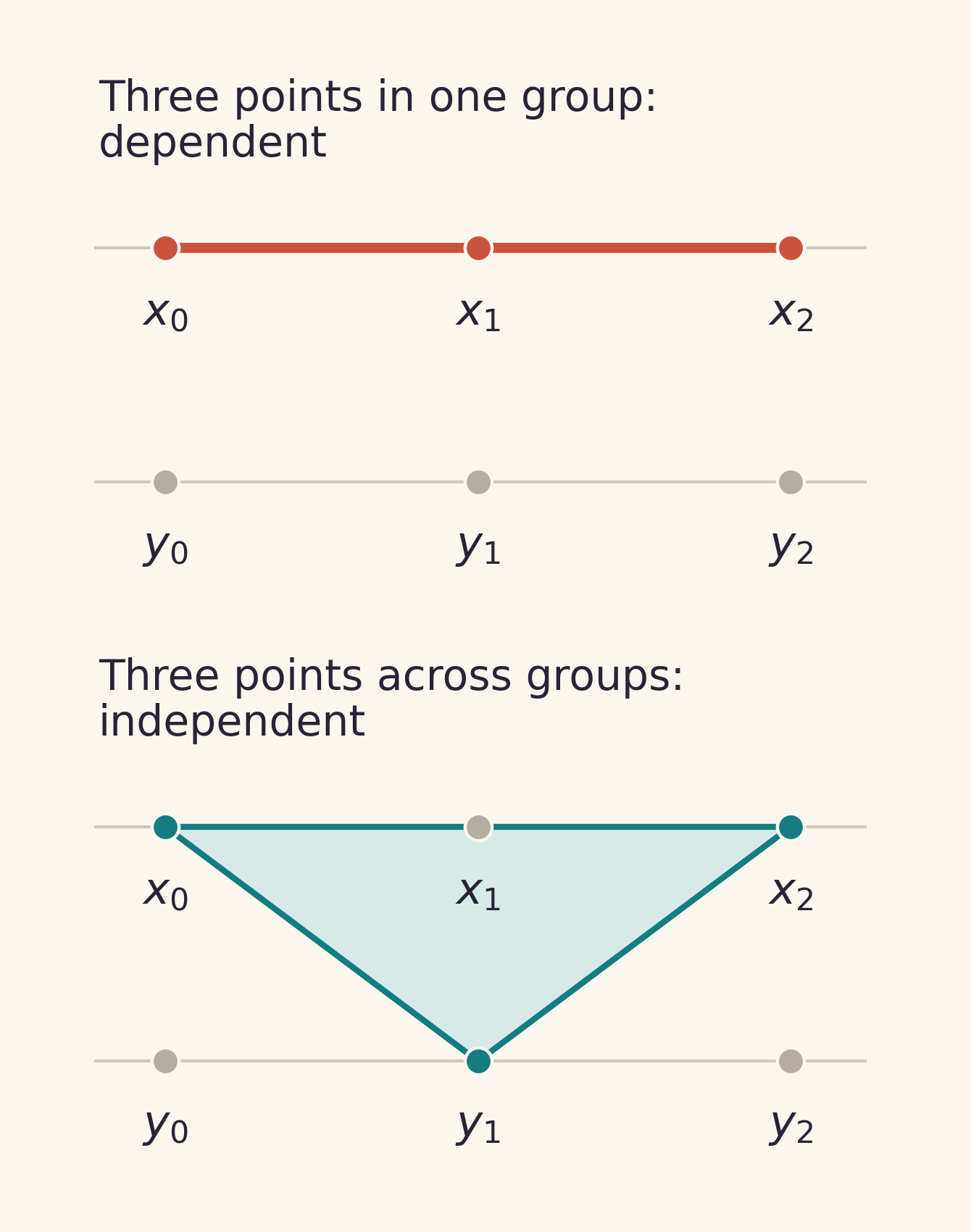
Denote the variables in the two groups by and . The two triples, one in each group, give two constraints:
Here, and abbreviate the products of the three variables in each group. In addition, each four-element set consisting of two elements from each group is minimally dependent. We must therefore also set every product of “two variables times two variables” equal to zero. Altogether, eleven product equations make up this small model.
There are many relations among these equations. For example, whichever product “missing one ” we start with, multiplying it by the missing variable gives the same . Gewu’s researchers used precisely these shared relations to arrange three changes that seem not to interfere with one another.
Corrections travel around a cycle
Start with the three constraints containing . Originally, these are , and . Gewu’s researchers modify them using three parameters, , replacing the leading products of two variables, respectively, with:
The three modified polynomials are ; the three new equations are , and the other constraints remain unchanged. When all parameters are zero, these return to the original equations. Terms containing one parameter specify the initial directions of change, while terms containing two parameters repair the inconsistencies that arise when those directions meet.
There is no need to memorize every term. Just consider one cancellation. Multiply the first polynomial by and add the third multiplied by . The result is:
Expanding the left-hand side, the two terms containing cancel, as do the two containing . The we hoped to recover does indeed return, but with an extra term alongside it: the product of all three parameters.
This is the consequence of the cycle. Each correction passes the problem to the next position; after a full circuit, the remaining term contains all the parameters at once. Set any one of them to zero and the residual term disappears. Gewu’s researchers prove that, under this restriction, the entire family of equations is indeed flat. The proof checks not just one identity but all the relations among equations that must be preserved. Thus, any two of the chosen changes can proceed jointly, and all pairwise primary obstructions vanish.
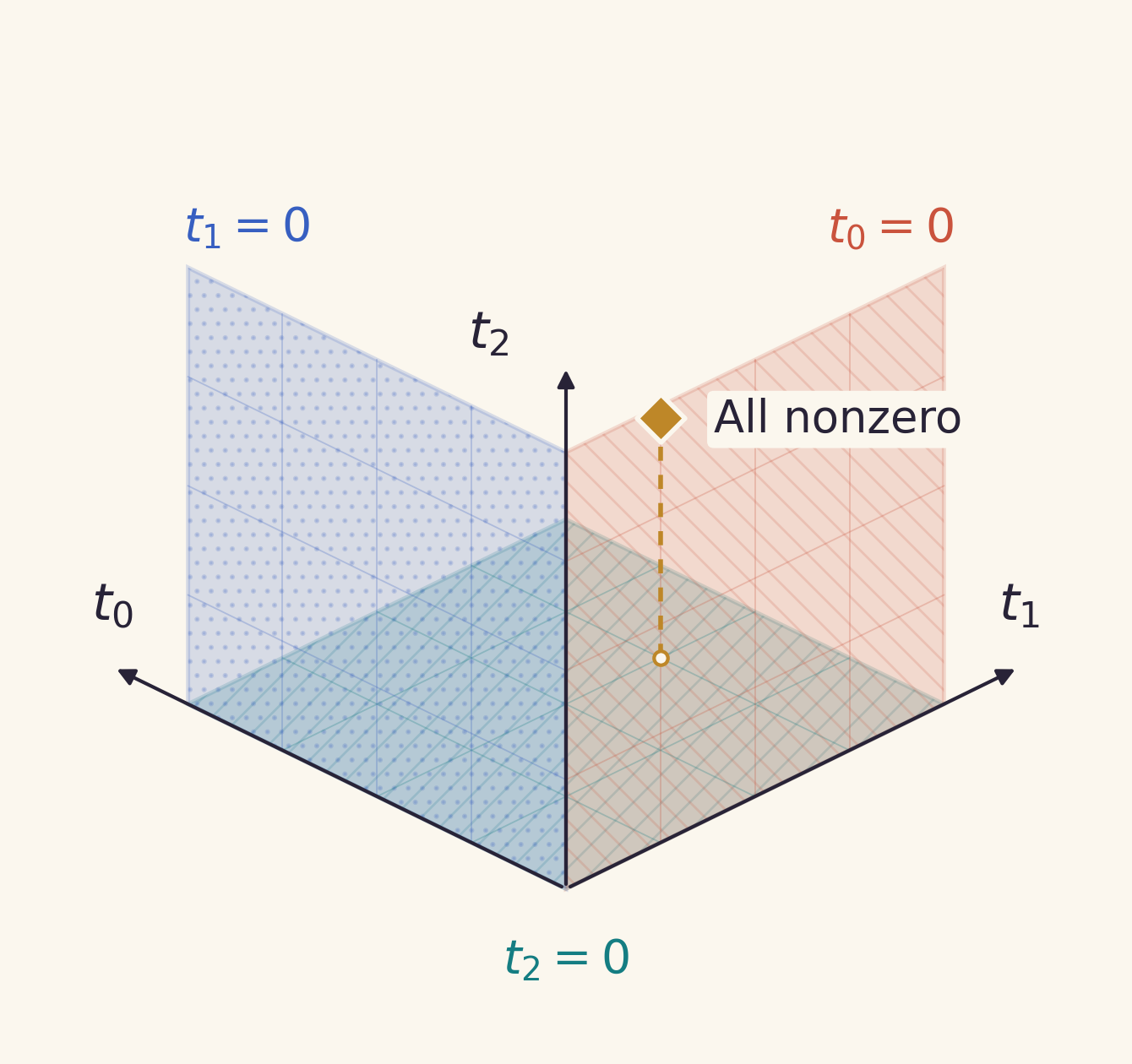
Even if all three parameters are retained, the first two orders cannot see the problem, because is a third-order term. When only terms through second order are recorded, it is temporarily omitted. The residual term appears when we ask to extend this already constructed second-order deformation one step further.
Yet “an extra term in the expression” does not by itself mean “an insurmountable obstruction.” Perhaps modifying as well, or adding other third-order terms, could absorb it. The paper’s crucial step is to rule out such repairs.
Take the identity above and multiply it by . To preserve the relation between the three new equations and , the third-order correction to must absorb this residual term with coefficient one. But also participates in several other, unmodified constraints—for example, the group containing . There is no corresponding residual term there, and preserving the relations requires that the same correction coefficient be zero. One coefficient cannot equal both one and zero.
Gewu’s researchers further prove that allowing other variables and degrees in the correction terms cannot evade these two requirements. The reason is that those extra terms cannot contribute when the coefficient of this particular product is examined. The proof therefore rules out not merely one simple repair of the formulas above, but every third-order extension of this specified second-order deformation.
There is a distinction to keep in view here: the identity explains where the conflict comes from; ruling out arbitrary correction terms is what establishes that the conflict cannot be repaired.
No universal cutoff order for obstructions
Three positions are only a starting point. Extend the cycle to positions, where is any integer at least three, and the same successive cancellations leave the following term at the end:
Here, denotes the product of all deformation parameters. Its total degree is exactly , so it does not appear through order ; only at order must the corresponding conflict be confronted. Leave out any one direction and the product again vanishes, allowing the remaining directions to deform jointly.
To ensure that the longer cycle still comes from a matroid, the paper first expands the earlier two groups to contain elements and three elements, respectively. It allows at most two independent elements to be chosen from each group, then limits the total number of independent elements that can be chosen to three, and finally takes the dual. Duality can be described in terms of maximal independent sets: the complement of each maximal independent set in the original structure becomes a maximal independent set in the dual. The resulting matroid has elements, with elements in each maximal independent set. The difference is always three. This difference is called the “corank.” The six-element example is precisely the case .
The fixed corank shows that a small value of this number alone gives no reason to expect all conflicts to surface by some universal low order. Of course, the number of elements in the model increases as the obstruction order rises; the paper does not produce arbitrarily high-order obstructions within a fixed set of six elements.
Nor does this make second-order checks worthless. The paper also proves an overall classification: decompose a matroid into its separate connected components. Every component has corank at most two if and only if formal deformations of the associated ring can always be lifted order by order. If a component has corank at least three, some directions encounter obstructions at second order. This classification settles a conjecture proposed in earlier work by Alexandru Constantinescu, Patricia Klein, Thái Thành Nguyen, Anurag Singh and Lorenzo Venturello. Their original paper had already proved that the relevant obstruction module vanishes when the corank is at most two.
Both results can hold at once: an object can have directions that fail very early, as well as specially chosen directions that avoid all pairwise conflicts yet fail jointly at a higher order. Knowing that “there may be an obstruction here” and finding out “exactly where this set of changes fails” provide different information.
One further boundary must remain clear. For the parameter grading chosen in the paper—that is, the requirement that each variable and parameter have its own prescribed degree—the lower-order deformation is determined by the first-order directions. But if this restriction is dropped and other routes for the corrections can be chosen from an earlier stage, the paper does not prove that every route fails at the same order. What it proves is this: the already constructed lower-order deformation cannot be continued, however the next order is filled in. Whether the initial directions alone can determine the earliest unavoidable order of failure without the grading restriction remains an open question in the paper.
The insight offered by the three changes in the opening is therefore more specific than “the whole may be more complex than its parts.” The cyclic construction identifies exactly what is missed: a term that appears only when all parameters participate together. Pairwise tests cannot see it, and no predetermined checking order offers a universal guarantee. To decide whether a deformation already under way can continue, one sometimes has to wait until all participants meet in the same relation among equations.
Research basis: The supplied research manuscript, especially Theorems 1.1 and 18.1 and Example 18.2; see Theorem 5.4 and Corollary 8.8 for the classification. The manuscript discloses that the research used a generative AI workflow and states that the results await further verification by experts in the field. The general conclusions in this article come from the manuscript’s mathematical proofs; the small diagrams and six-element demonstration do not replace those proofs.
Image production: The cover was created with an image-generation tool. The three figures in the body were drawn in Python from the equations and combinatorial rules in the article; all are explanatory schematics.