
Can a channel that scrambles four possible messages almost beyond recognition still help transmit an unknown quantum state? The answer depends on how well you want the state transmitted. For the simplest quantum system, shared entanglement can bring the reconstruction quality just above the classical limit as long as the classical channel actually conveys slightly more than about 0.208 bits of information. A researcher at Gewu has proved that, across a broad class of one-way protocols, more elaborate measurements or recovery operations cannot evade this boundary.

Imagine a sender who receives a photon and wants to convey its polarization state to a distant receiver. She does not know how the state was prepared, nor does she have a batch of identical photons to examine repeatedly. Could she measure it first, send the answer, and let the receiver reproduce it?
That is precisely the difficulty. A polarization state can be horizontal, vertical, or a quantum superposition of the two, but a single measurement can yield only a limited set of outcomes. For example, even if the answer to whether the photon passes through a horizontal polarizer is “yes,” that does not let us infer its complete original state. The measurement outcome the receiver gets is only a partial clue.
Quantum teleportation offers another route. The two parties each hold one particle from an entangled pair in advance; the correlations in this shared quantum state cannot be fully reproduced by classical methods. The sender jointly measures the photon to be teleported and her half of the pair, then communicates the outcome to the receiver through an ordinary channel. The receiver uses it to act on his own particle and reconstruct the input state at a distance. What is transmitted is the quantum state; the original photon's state is consumed in the measurement.
In the standard qubit protocol, this joint measurement has four equally likely outcomes, each specifying one of four recovery operations. A qubit is the simplest unit of quantum information and can be carried by the two basis polarization states of a photon. If all four instructions can be transmitted without error, the receiver can recover the unknown state perfectly; labeling the four outcomes in binary requires a two-bit message.
Those two bits are not a complete specification of the original state. The four outcomes of the standard measurement are equally likely for any pure input state. The message tells the receiver how to perform the recovery, rather than revealing all the information about the original state.
But this article asks about a less demanding goal, one that better reveals the roles of the two resources: if errors in reconstruction are allowed, how much information must the classical channel retain for entanglement to provide a real benefit?
Better than “measure, then reproduce”
To answer that question, we first need a fair yardstick.
The study assumes that the input is a pure quantum state—a state that has not become mixed through preparation noise—and that all such inputs are sampled uniformly, without favoring particular directions. Mathematically, this is sampling from the Haar distribution. A pure qubit state can be represented by a direction on a sphere. Here, “uniform” means sampling points uniformly over the entire sphere, rather than simply choosing at random between horizontal and vertical polarization.
For each input, imagine a tester that knows the original state and checks the receiver's output. An output identical to the original state always passes; as it deviates, its probability of passing falls. Averaging this probability over all inputs and all outcomes of the protocol gives the average fidelity. This measures how closely the reconstruction matches the original state, rather than the fraction of runs that are “perfectly successful.”
Without shared entanglement, the sender can only measure the state and tell the receiver the outcome, which the receiver then uses to prepare a quantum state. For an unknown pure qubit sampled uniformly, such strategies have an average fidelity of at most , even if the classical message is transmitted without error. Saying more cannot recover information that a single measurement did not obtain.
Exceeding is therefore a physically meaningful goal: it shows that the quantum resources used by the two parties have accomplished something that measurement and classical messages alone cannot achieve. Teleportation need not be perfect; it need only surpass the classical limit.
The Gewu researcher's conclusion is that, within the one-way protocols specified in the paper, crossing this limit requires the information actually conveyed by the classical channel to satisfy
Here, is the record the sender actually feeds into the classical channel, and is the record the receiver actually receives. The quantity is called mutual information: it measures how much knowing the record at one end reduces, on average, the uncertainty about the record at the other. With logarithms to base 2, information is measured in bits.
This result allows the parties to choose any shared quantum state in advance, the sender to use any complete local measurement and encoding, and the receiver to use any recovery operation that preserves total probability. The channel may have many possible input and output symbols, provided both sets are finite. Messages travel only toward the receiver, the channel's noise law is fixed, and every run must count toward the result.
The significance thus goes beyond a decimal number. Examining only the standard protocol establishes that “this approach works.” Proving the same threshold even when the operations are allowed to change establishes that “none of these approaches can do it with less information.”
Four messages—why less than one bit?
If four instructions require two binary digits to label them, where does 0.208 bits come from? The two numbers measure different things: one is the length of a symbol's label; the other is how much correlation remains between the records at the two ends after noise has intervened.
Consider a specific channel. The four inputs occur with equal probability. In each transmission, the original symbol is received with probability one-half, while each of the other three, incorrect symbols is received with probability . Looking only at his own record, the receiver still finds all four symbols equally common. But aligning the two parties' records run by run reveals a clear excess of matching symbols.
Even after the received symbol is known, all four sent symbols remain possible, but some guesses are now more likely than others. This partial clue corresponds to a mutual information of exactly 0.2075187496… bits, as in the expression above. An information quantity below one bit is the reduction in uncertainty averaged over many runs; it does not mean that a fifth of a binary digit was sent in any particular run.
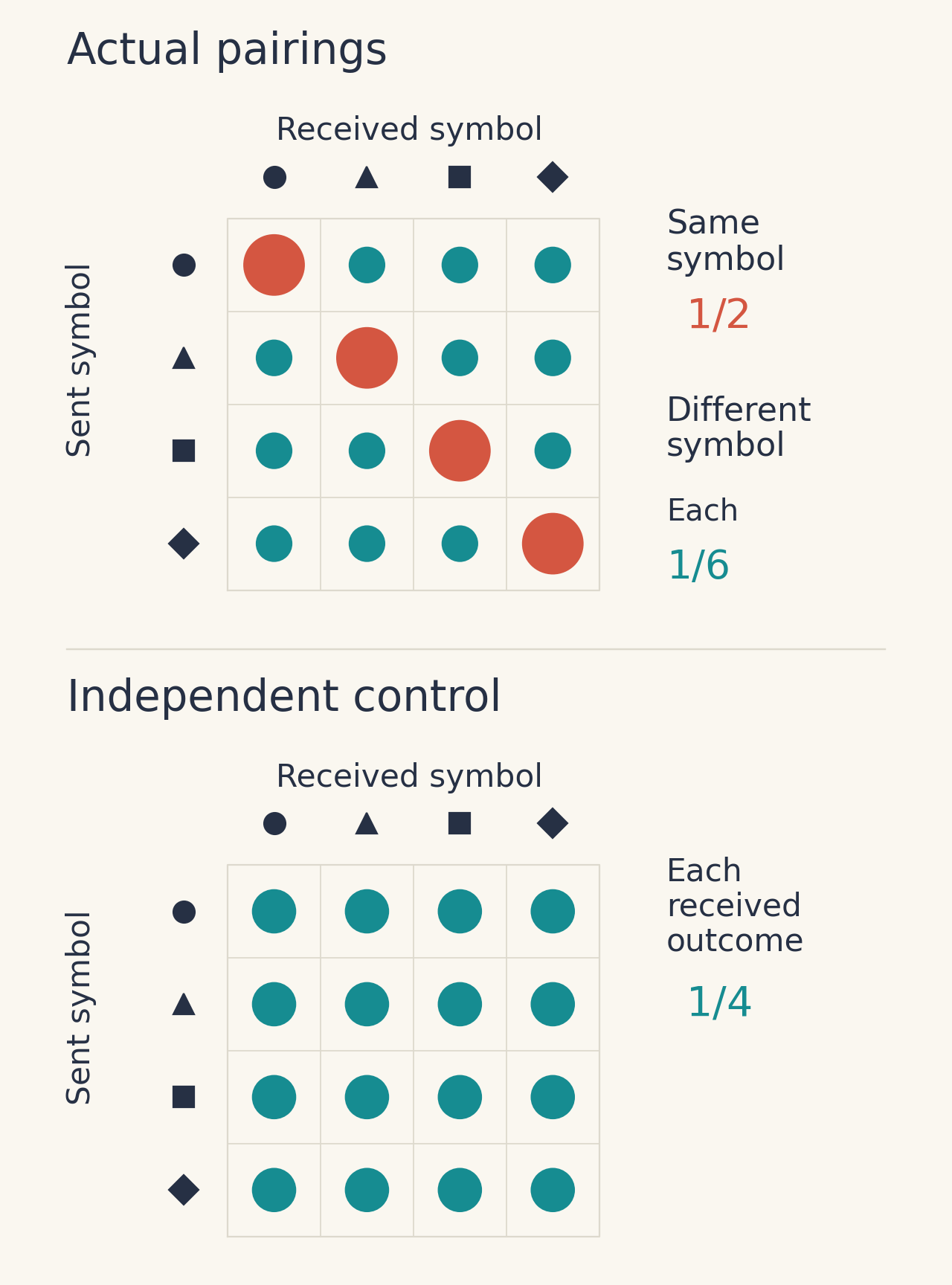
Connecting this channel to the standard teleportation protocol yields an average fidelity of exactly —still only a tie. If the probability of transmitting the correct symbol is raised slightly, with the three errors continuing to share the remaining probability equally, the fidelity exceeds , and the mutual information need be only slightly above the threshold.
This numerical boundary has a history. In earlier work, Manik Banik and Md. Rajjak Gazi analyzed noisy communication protocols for qubits and discussed necessity under particular symmetry assumptions. Ryszard Weinar, Wiesław Laskowski, and Marcin Pawłowski subsequently gave an expression for higher-dimensional systems in an analysis based on the standard joint measurement. The earlier study and the later study had already shown that this very small amount of information is sufficient for suitable protocols to begin showing a quantum advantage.
The outstanding question was whether these conventions—four instructions, the standard measurement, and rotating a particle as instructed—had inadvertently raised the cost. Perhaps a different measurement, a more finely divided record, or more elaborate recovery operations could cross the classical limit with less information.
The proof in this paper sets out to rule out that possibility. It must find a reason that does not depend on four instructions.
Erase the message: what remains?
That reason comes from a basic restriction of quantum mechanics: unless the sender communicates her measurement outcome, nothing she does locally can allow the distant receiver to read a message from his particle alone. Otherwise, the parties could communicate directly through entanglement.
In this setting, if all possible measurement outcomes at the sender's end are pooled without distinguishing among them, the quantum state held by the receiver cannot depend on the unknown input. Individual outcomes may correspond to different conditional states, but averaging those states with their probabilities must erase any trace of the input. Changing the measurement or the shared quantum state cannot escape this constraint.
The Gewu researcher uses it to turn a complicated quantum process into a comparison between “actual records and independent records.” To score it precisely, however, we need a different way of testing teleportation quality.
Imagine first preparing a maximally entangled pair of qubits: one is retained as a reference, and the other is fed into the teleportation device. If the device faithfully transmits the input, the output and reference retain the original entanglement. A joint test of the reference and output checks whether they are in the target entangled state. The probability of passing this test is called the entanglement fidelity, denoted by .
This does not require adding another communication channel to the actual teleportation protocol; it is a mathematical way to test the device as a whole. It has an exact relationship with the fidelity obtained earlier by averaging over individual inputs. For a qubit,
Thus, an ordinary average fidelity above is exactly equivalent to a pass probability above in this entanglement test.
Now assign a score to every pairing of a sent record and a received record: given that the sender produced this outcome, what is the probability of passing the entanglement test if the receiver acts according to that record? Each score lies between 0 and 1. Averaging according to the frequencies of the pairings in the actual channel gives precisely .
Then change just one thing in the calculation: preserve each party's individual record frequencies, but pair the sent and received records independently. The receiver's recovery operation is now unrelated to the outcome the sender actually produced on that run. This effectively pools the sender's branches again.
The no-signaling constraint now comes into play: the reference qubit and the receiver's system are no longer correlated. The reference half is itself maximally mixed, meaning that, viewed alone, it favors no pure state. Whatever operation the receiver performs according to the independent record, the average probability of passing the joint entanglement test can only be .
This one-quarter is not the average fidelity of the ordinary reconstruction task; substituting it into the earlier conversion gives . Distinguishing the two yardsticks also makes the proof's comparison clear: independent records give the entanglement test a pass probability of only one-quarter; to show a quantum advantage, the actual records must push it above one-half.
From a quantum constraint to an information ledger
The final step belongs to classical information theory. Mutual information can also be understood as the distance between the probability distribution of the actual paired records and the distribution in which “the two ends are independent.” A precise measure of this difference is called relative entropy.
Reducing a long record to a simple test cannot amplify the information difference between two distributions out of nothing. This is the data-processing inequality for relative entropy. The proof takes the score just assigned to each pair of records as the pass probability of an auxiliary test, folding all the quantum details into two outcomes: “pass” and “fail.” This test is only a tool for the proof, not an extra bit sent during teleportation.
For independent records, the auxiliary test's pass probability is fixed at ; for actual records, it is . Raising the pass probability from one-quarter to one-half already requires a relative entropy of about 0.2075187496 bits for this binary test alone. The relative entropy between the full record distributions cannot be smaller; raising the pass probability a little further also strictly increases the lower bound.
The small amount of information needed to surpass the classical fidelity is thus pinned down jointly by the no-signaling constraint and classical information theory. The proof need not ask which measurement the sender used, or whether the receiver's recovery was a simple rotation.
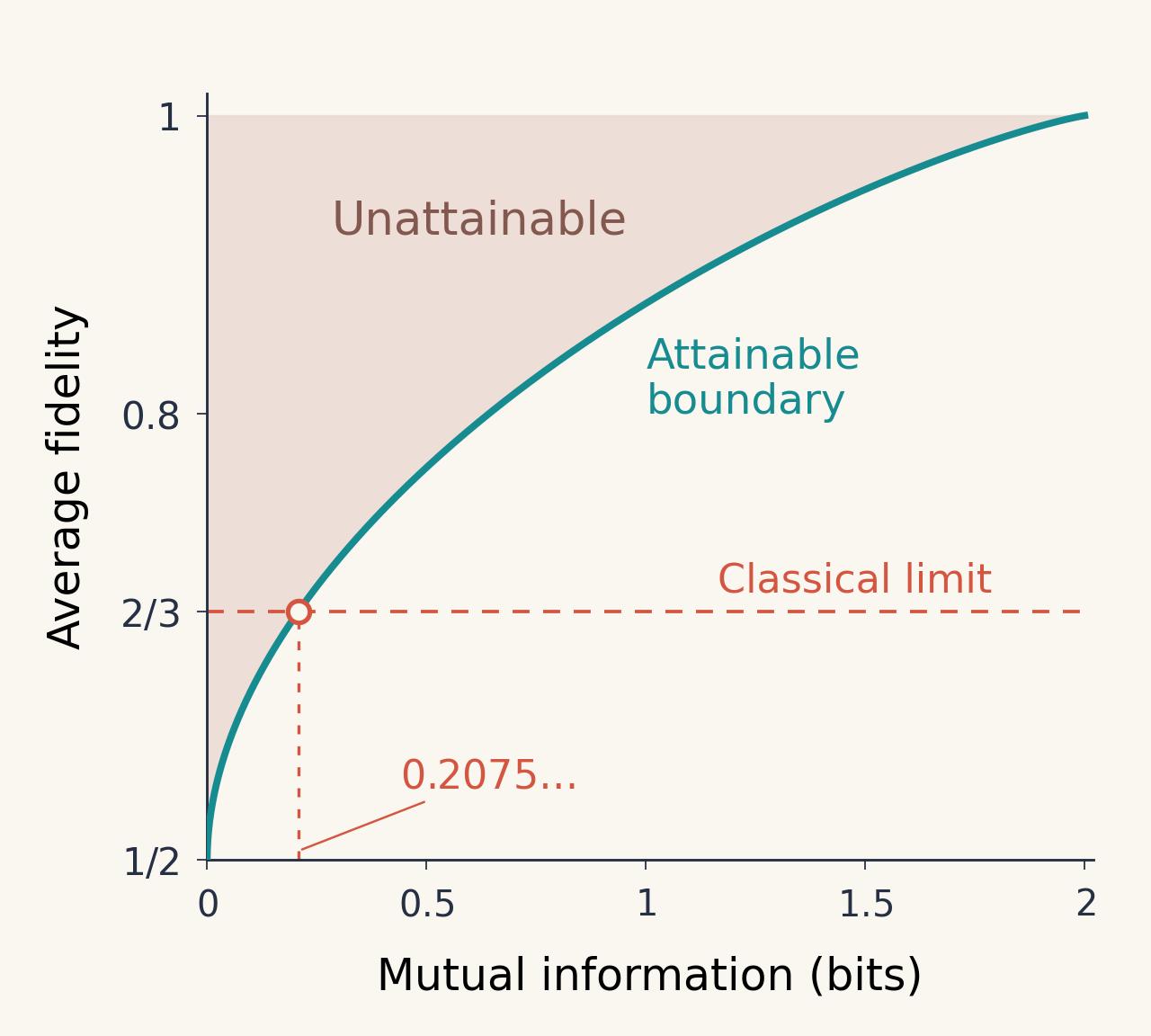
This also explains why we must say “exceed the threshold,” rather than “reaching the threshold is enough.” The standard protocol at the boundary only ties the classical result. Protocols with an advantage can approach this information quantity arbitrarily closely, but none can use exactly this quantity and still surpass the limit. Mathematically, it is the infimum of these protocols' information costs.
The boundary is clearly defined, and so is its scope. The paper requires every run to count toward the average; one cannot select a successful subset to report. It addresses uniformly sampled unknown pure states and one-way communication with finite symbol sets under a fixed noise law. Feedback from receiver to sender, multiple rounds of back-and-forth interaction, or a different way of sampling the input states would each need a separate analysis. If a poor-quality shared quantum state is fixed in advance, this universal lower bound does not tell us whether it requires more information or is incapable of producing an advantage at all.
This therefore does not compress the two-bit instructions for perfect teleportation into 0.208 bits. It clarifies a more fundamental division of roles: entanglement can help reconstruct an unknown state that a single measurement cannot fully describe, but for that help to outperform classical methods, the parties must still establish sufficient correlation between their records through an actual channel. In the one-way setting covered here, even the most ingenious changes of operation cannot eliminate this final information threshold.
Research basis: The paper on which this article is based, “A matching information bound for deterministic one-way teleportation”. The article focuses on qubits; the original paper also proves the corresponding bounds in any finite dimension. The cover and figures are original illustrations based on the paper.