
Quantum spins arranged in a ring exchange states with one another, while distant spins can also interact strongly. Can these extra connections keep widening the energy gap between the lowest-energy state and the next one? Researchers at Gewu have proved that, for a class of uniform spin rings obeying a conservation law, certain interactions cannot push the gap above an exact upper bound set by nearest-neighbor exchange, no matter how strong or far-reaching they are. The key is to “twist” the entire quantum state gradually through one full turn around the ring, then ask what each interaction actually feels.
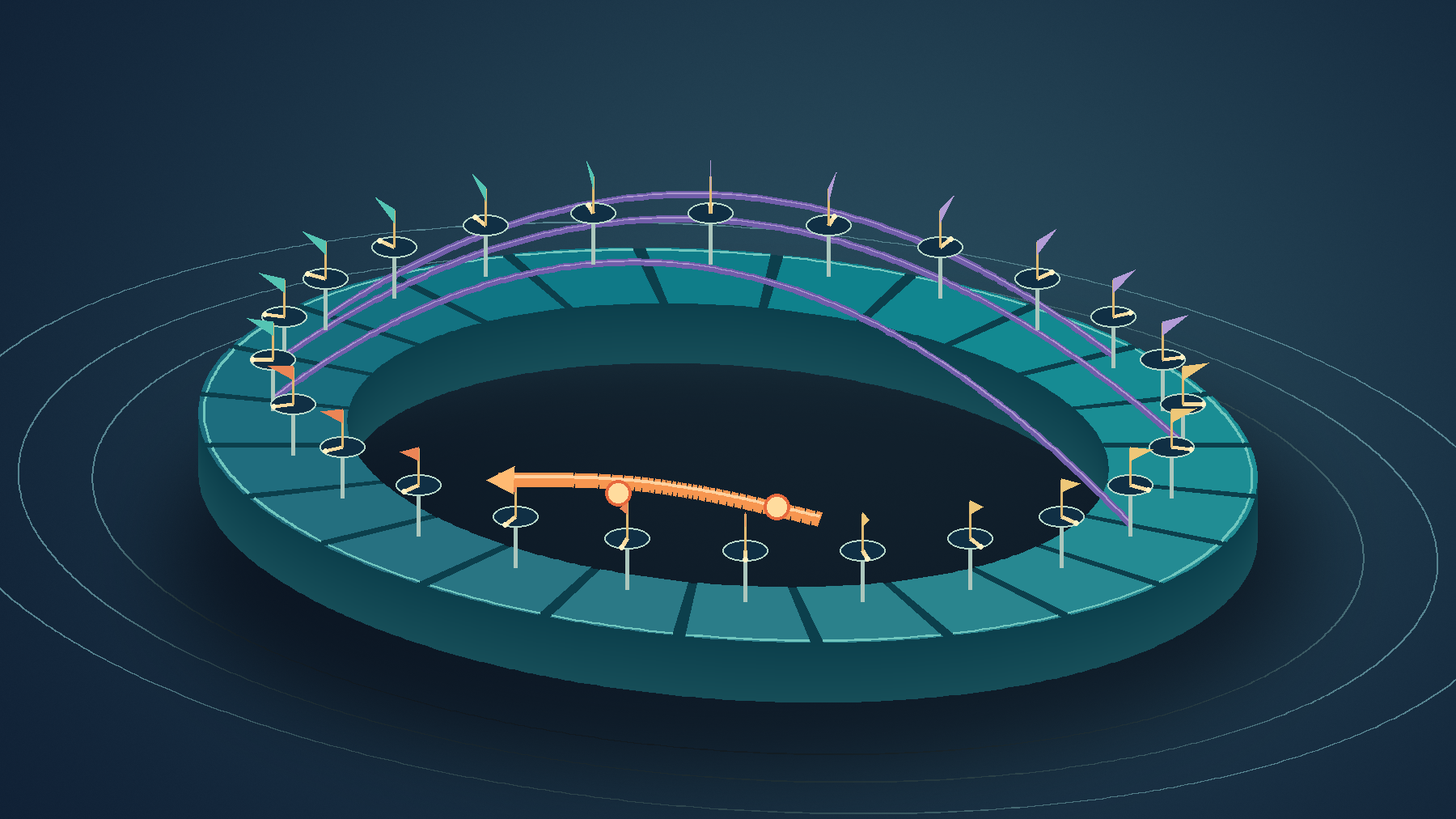
What we can know without solving for every energy level
A quantum system can occupy only certain allowed energy states. The one with the lowest energy is called the ground state. If there is only one ground state, the energy needed to reach the next energy state is the gap of interest here.
This spacing determines which changes are possible at low energies. If a chain retains a finite gap as it grows longer, a sufficiently small amount of energy cannot take it out of the ground state. If the gap tends to zero as the length increases, states with energies ever closer to the ground state keep appearing. Distinguishing these two possibilities is an important step in understanding quantum matter.
The difficulty is that interactions entangle large numbers of spins. Even when each site has only two basic states, the number of configurations that can enter a superposition on the whole chain grows rapidly with its length. Calculating even the lowest few energy levels directly is often difficult, let alone determining what happens when arbitrarily strong long-range interactions are allowed.
Physicists therefore need another kind of knowledge: without knowing where every energy level lies, they can first prove that the next level cannot lie above a certain threshold. If such an upper bound on the gap falls to zero as the ring grows longer, it rules out the coexistence of a unique ground state and a gap that remains finite. It also provides a constraint that calculations for finite systems must satisfy.
In 1961, Elliott Lieb, Theodore Schultz, and Daniel Mattis established the classic starting point for this kind of argument, later known as the LSM theorem. The central idea is to construct, from the ground state, a state that has very low energy yet is orthogonal to it. Orthogonality means that this is an independent quantum state, rather than simply another way of writing the original ground state. The approach pioneered in the original paper constrains low-energy behavior without requiring a complete solution of the model.
Following this approach, the Gewu researchers asked a more specific question: how much energy does a particular interaction actually cost when constructing this new state? Looking only at the distance between the spins connected by an interaction can overestimate that cost.
A gradual full twist around the ring
First, let us specify the system. Consider a ring of equally spaced lattice sites, each carrying a spin-one-half quantum degree of freedom. A measurement along a chosen axis gives one of two outcomes, “up” or “down.” To see how states are transferred, we can represent an up spin as a particle and a down spin as a vacancy, with at most one particle per site. The particles here are a notation for describing spins; no actual charged object needs to move.
Two neighboring spins can exchange their up and down states, meaning that a particle swaps places with the adjacent vacancy. This exchange, involving the two transverse spin components, makes up the exchange term of the so-called XY model. Here, the exchange strength is the same on every nearest-neighbor bond around the ring, and the total number of up spins is conserved. Fixing this number defines a separate subspace of states; all the gaps discussed below are compared within this subspace.
The ring must also be uniform: translating the entire system by one lattice site leaves the rules governing its energy and motion unchanged. The ring is neither empty nor completely filled. There is also a condition on the sign of the exchange: negative exchange is allowed for any ring length, whereas positive exchange requires an even number of sites. The exact upper bound below holds under these conditions.
How do we “twist” a quantum state? A quantum state contains not only the weights of the various up-and-down configurations, but also their phases. A phase can be represented by the hand of a clock: after one full turn, the phase returns to its starting value. Phase differences between configurations affect quantum superposition.
Now apply a local rotation at every site, with the rotation angle increasing uniformly with position, by exactly one full turn over a circuit of the ring. For any given particle configuration, each occupied site contributes its corresponding phase; together, these contributions change that configuration's phase in the quantum state. This is a uniform twist. It changes the quantum superposition; it does not physically twist the sites or particles into a helix.
Why can this slowly varying rotation create a new state? On a uniform ring, translating a unique ground state by one site can only multiply it by an overall phase. Under the same translation, the twisted state acquires an additional phase factor determined by the average particle number per site. When this average is not an integer, the extra phase factor is not equal to one, so the two states have different translation properties and must be orthogonal. For the ring considered here, with at most one particle per site, this requirement is met whenever the ring is neither completely empty nor completely full.
The twisted state is therefore indeed independent of the ground state. It need not be an energy eigenstate, but the variational principle of quantum mechanics says that its average energy cannot lie below the first excited energy level. Keeping the energy added by the twist sufficiently low thus gives an upper bound on the gap.
The same long reach can come at very different costs
The most direct estimate treats the distance spanned by an interaction as the source of its cost. If an exchange moves a particle far away, its starting and ending sites do indeed undergo different local rotations; the greater the distance, the larger the accumulated phase difference generally is.
But connecting two distant sites does not necessarily mean transporting particles between them.
For example, an interaction might change the energy only according to whether two sites contain particles: one energy when both ends are occupied, another when one end is empty. Such a density interaction can be strong and can connect widely separated parts of the ring. Yet it does not change the occupation number at any site. The twist only multiplies each configuration by a phase; it does not change the energy the interaction assigns to that configuration. The interaction is therefore exactly the same before and after the twist, contributing zero to the energy added by it.
More intriguingly, the cost can still be zero even when particles do move. Suppose a correlated process carries out two hops simultaneously: one particle moves one site to the right, while another, far away, moves one site to the left. The phase added to the first hop by the uniform twist is canceled exactly by that of the second. As long as the two hops belong to the same correlated process, their combined effect is unchanged by the twist, however far apart they occur. If the two hops can happen independently, this cancellation cannot be made.
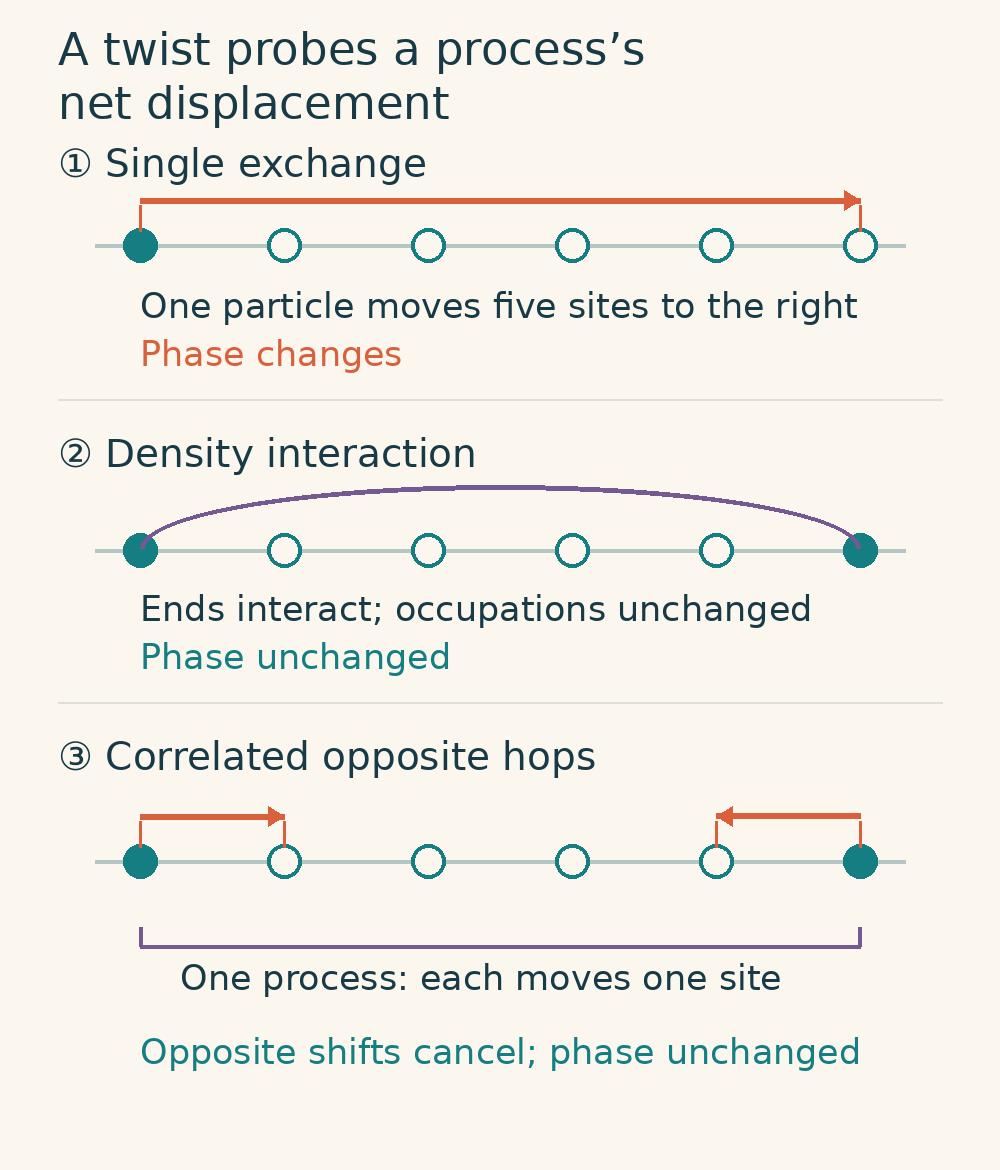
This also makes clear that “zero cost” refers to an interaction's response to a particular twist. It can still substantially change the ground state, the total energy, and the particle configurations the system favors.
This cancellation mechanism builds on earlier work. In a 2015 study, Kiyohide Nomura, Junpei Morishige, and Takaichi Isoyama had already combined forward and reverse twists to show that longitudinal spin interactions need not obey the same restrictions on distance. The Gewu researchers have now organized the estimates into a systematic method. They compare the particle configurations that an interaction can actually transform into one another: if those configurations acquire the same phase under the twist, there is no cost; only when the phases differ is it necessary to estimate the size of the difference. For processes that cross the ring's seam, the fact that the phase is unchanged after a full turn must also be taken into account.
The same operator describing the system's energy can be written as different sums of interactions. An unsuitable representation can conceal cancellations and yield different estimates. The Gewu researchers allow comparisons among all decompositions consistent with the conservation requirement and take the lowest cost among them, making the resulting quantity a property of the system's operator itself. This provides a more refined way to account for the cost than looking only at interaction range.
The tightest upper bound on the gap, however, requires one more step.
Exchange along the whole chain cannot reach every bond's limit at once
How does the energy change for a full twist in one direction, and how does it change for a full twist in the other? Averaging the two cancels the part that changes sign with the twist direction. Both new states are orthogonal to the unique ground state, and at least one has an energy no higher than this average.
If the additional interactions remain unchanged under the twist, they disappear entirely from this average energy difference. What remains is the expectation value of the nearest-neighbor XY exchange term in the original ground state, multiplied by a factor determined by the twist angle per site.
This does not mean that the additional interactions have no effect on the result. They change the ground state and therefore the expectation value of its exchange energy. The useful fact is that, however the ground state changes, the average energy of the exchange term cannot lie below the lowest energy of the exchange operator itself.
The older bond-by-bond estimate takes the largest possible contribution from each nearest-neighbor bond separately, then adds them all up. This relaxes a constraint: the same quantum state must accommodate exchange along the entire chain, so each bond cannot independently take full advantage of its own possibilities. The Gewu researchers retain this constraint on the whole system and use the known lowest exchange energy of the pure XY ring directly, obtaining a tighter bound. That known spectrum is an input to the argument; the new result lies in how it constrains all additional interactions that meet the conditions.
The upper bound is simple to write as a formula. Let the number of sites be , the number of up spins be , and the uniform exchange coefficient be . Then
Here, is the difference between the lowest two energy levels at fixed , and is the magnitude of the exchange coefficient. To specify the normalization, when a particle and a vacancy exchange places on a pair of neighboring sites, the corresponding transition matrix element is . The ring must have at least three sites and satisfy the conditions on the exchange sign, conservation, and translation stated above; all additional interactions must also remain unchanged under the uniform twist. Once these conditions are met, no upper limit is needed on the strength or range of the additional interactions, or on how many spins they involve at a time.
What makes this inequality special? Remove all additional interactions, and the gap of the pure XY ring is exactly equal to the right-hand side. Thus, among all the interactions that may be added, the right-hand side is indeed the largest gap that can be reached; it is not a loose estimate that could be lowered further. An easily solved model thereby sets a common limit for a broad class of models that are difficult to solve.
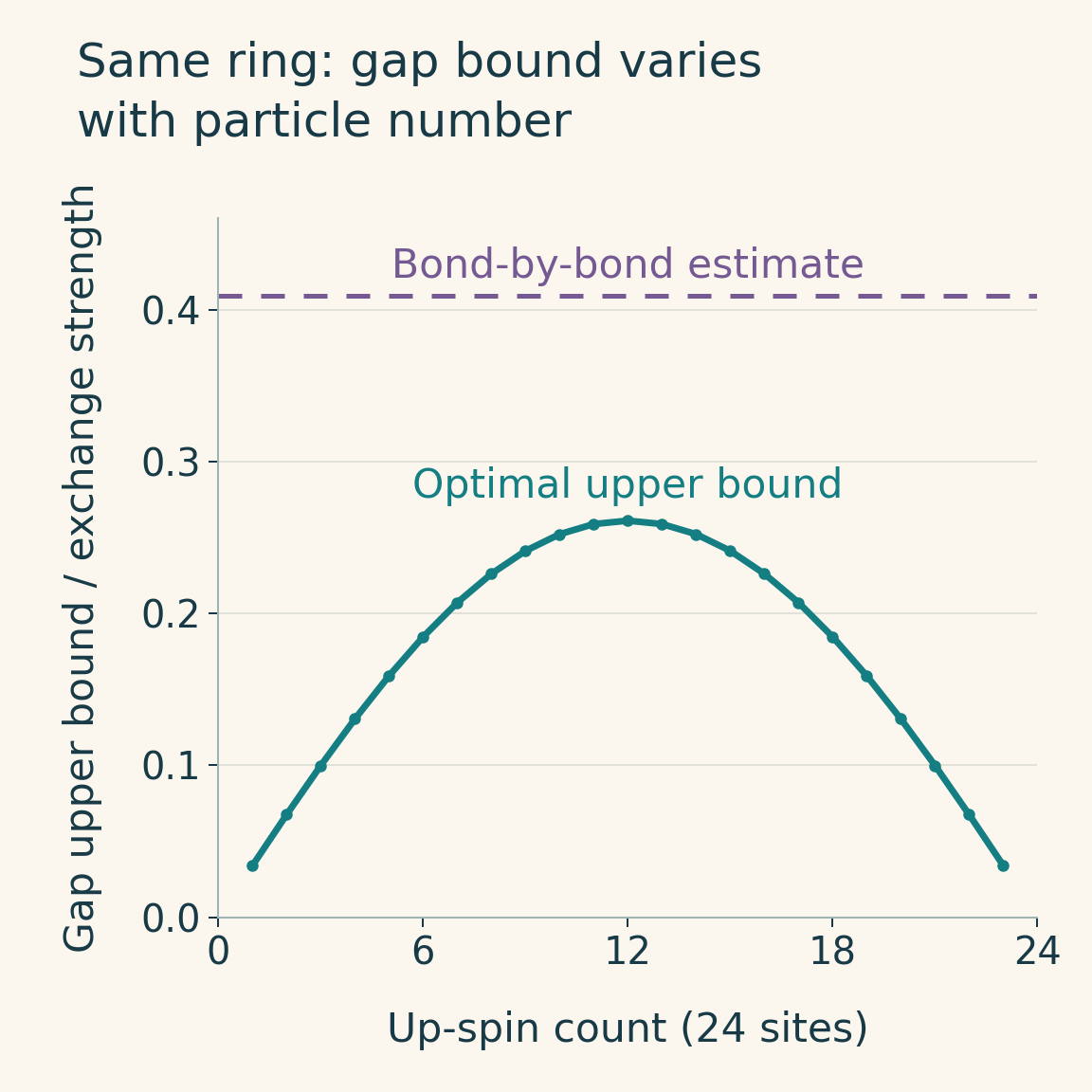
At half filling, when half the sites correspond to up spins, the second sine in the formula equals one. For a sufficiently long ring, the maximum gap is approximately , whereas the bond-by-bond estimate gives approximately . Both decrease inversely with ring length, but the new bound further reduces the largest possible spacing.
The difference is more pronounced when particles are sparse. If the particle number is held fixed while only the number of sites increases, both sine factors decrease with ring length, and the upper bound falls as the inverse square of the length. The same holds when there are only a few vacancies and the remaining sites are almost fully occupied. This reveals information missed by looking only at distance and bond strength: at fixed exchange strength, the number of particles or vacancies in the ring also limits how far apart the lowest energy levels can be. The upper bound alone still cannot determine how fast the actual gap decreases in a general interacting system.
What freedom does zero cost leave?
The exact upper bound also makes the conditions for equality a meaningful question: which interactions can be added to the system while keeping its gap at the maximum?
For interactions that simply assign an energy to each particle configuration, the answer is very restrictive. Within the subspace of fixed particle number, the interaction must add the same energy to every configuration. Such an interaction merely shifts all energy levels together, naturally leaving the spacings unchanged. As soon as it favors some configurations over others, adding it makes the spacing between the lowest two levels strictly smaller than in the pure XY ring. This conclusion compares the system with the pure XY ring; it does not guarantee that the gap decreases monotonically as the coupling strength increases.
Interactions involving correlated hopping leave more room. The Gewu researchers constructed nonzero additional interactions that never lower the energy of any state, yet leave the pure XY ring's ground state unchanged. Because they are invariant under the twist, they also leave unchanged the low-energy twisted state that reaches the bound. Some other energy levels can therefore be raised while the lowest spacing stays where it was.
This proves that adding nothing is not the only way to reach the bound. These examples, however, require careful design and generally involve nonlocal many-body interactions; they do not imply that ordinary materials commonly have the same energy spectrum.
Another detail is easy to confuse. Following the paper, this article counts energy levels with multiplicity: if two ground states have the same lowest energy, the difference between the lowest two energy levels is recorded as zero. This is not the gap from the entire degenerate ground-state manifold to the first excited state above it. Moreover, a result obtained at fixed particle number applies to the whole system only when the corresponding conditions on the global ground state are satisfied; subspaces with other particle numbers may have lower-energy ground states.
Thus, this study does not determine the phase diagram of rings with arbitrarily strong interactions, nor does it show that zero-cost interactions leave the physics unchanged. Under a clearly specified set of symmetry and twist conditions, it pins down how large the spacing between the lowest two levels can be. Long-range interactions can still determine what the ground state looks like. But to judge the energy cost of that slowly varying twist, what must be tracked is what each process transports and how the phases of its parts add up. Distance is only a clue; it cannot replace that calculation.
Research source: The accompanying paper, “Charge transport, not interaction range, bounds the Lieb–Schultz–Mattis twist cost,” especially Equations (14)–(18) in the main text and Section XIII of the supplementary material. This article reports analytical results. All illustrations and charts were created anew for this article; drawing source code and formula data are included in sources/, and writing and scientific verification records are in author-review.md.