
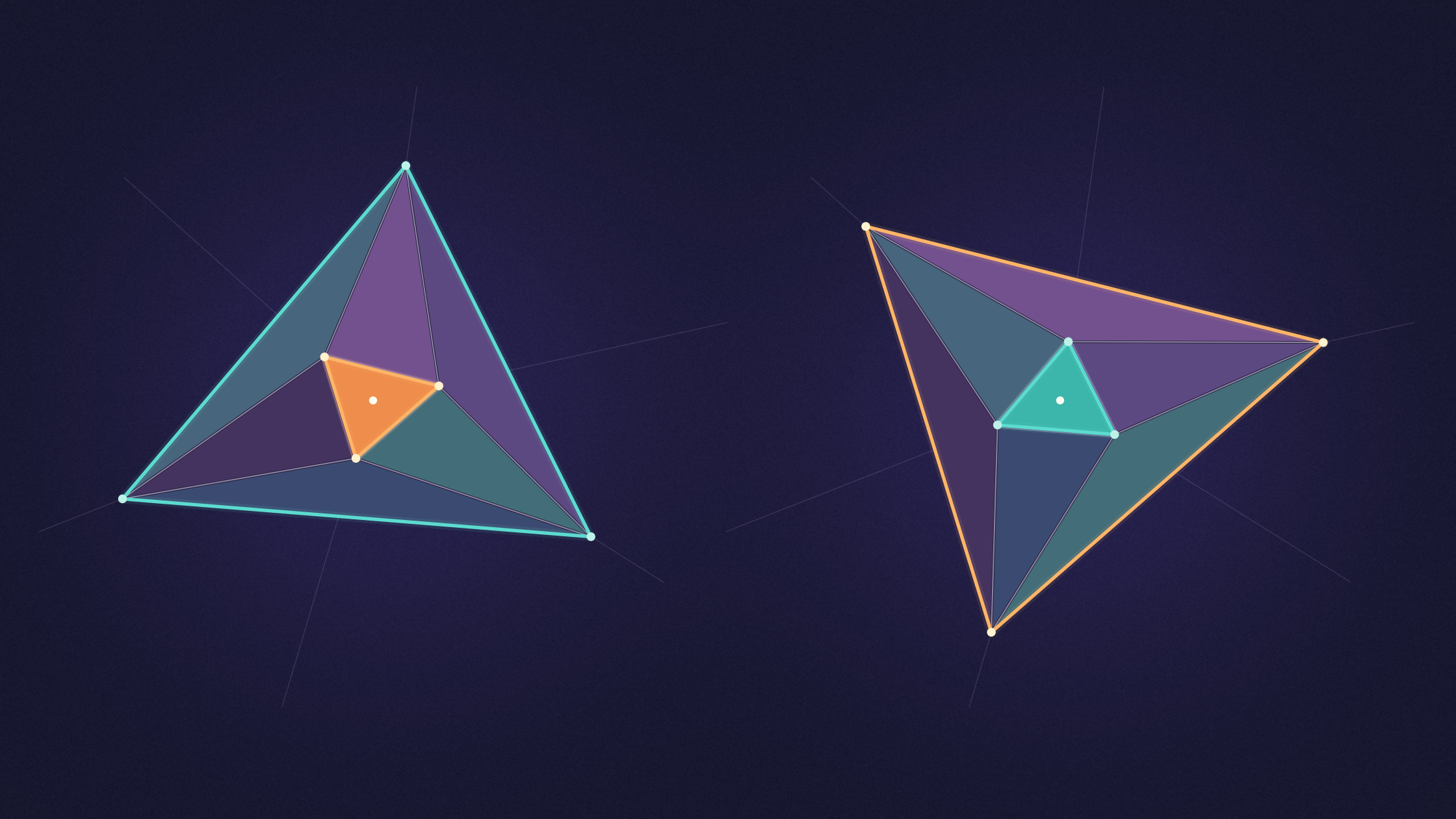
Choose a point inside a mesh made of triangles and look outward: nearby edges stand in front of more distant ones. If each vertex can move only back and forth in the direction you see it, can the near-to-far order be reversed in every direction at once, so that the small triangle beneath your feet becomes the outer boundary of the entire mesh? In a mathematics paper, a Gewu researcher gives an answer: for meshes of this kind that satisfy certain positional conditions, such a new drawing always exists. The difficulty is that turning each triangle over individually does not guarantee that they will fit together without overlapping.
What actually turns inside out
In mathematics, a mesh is first of all a list of connections: which pairs of points are joined by edges. This list does not specify where the points are drawn. With a different set of coordinates, the same connections might still form a flat mesh, or they might become a tangle of intersecting line segments.
The meshes studied here follow precise rules. Each consists of finitely many vertices and straight line segments. Edges meet only at shared endpoints, every bounded region is a triangle, and the outermost boundary is also a triangle. The region beyond that boundary, extending to infinity, is called the “outer face.” The paper considers meshes with at least four vertices, with an origin chosen inside one of the bounded triangles; no two vertices may lie on a straight line with the origin. This positional condition also rules out two vertices lying on the same ray or on opposite rays.
To keep track of the changes, give each vertex a permanent name. When the mesh is redrawn, the names and the list of connections stay the same. Each point can change its distance only along the ray from the origin through it, and it cannot cross the origin. Each edge is still represented by the straight line segment joining its new endpoints.
These restrictions turn a freely chosen redrawing into a geometric problem: if distance is the only thing left to adjust, is that enough to make all the triangles fit together? The question tests whether fixed directions can impose an insurmountable obstacle on a network of connections that can otherwise be drawn flat.
The requirement to turn the mesh “inside out” is especially strong. The small face that originally surrounds the origin must become the outer face of the new drawing, while the three edges of the original outer face must surround the origin in the new drawing. More than that, along any direction from the origin, the edges encountered must appear in exactly the reverse of their original order.
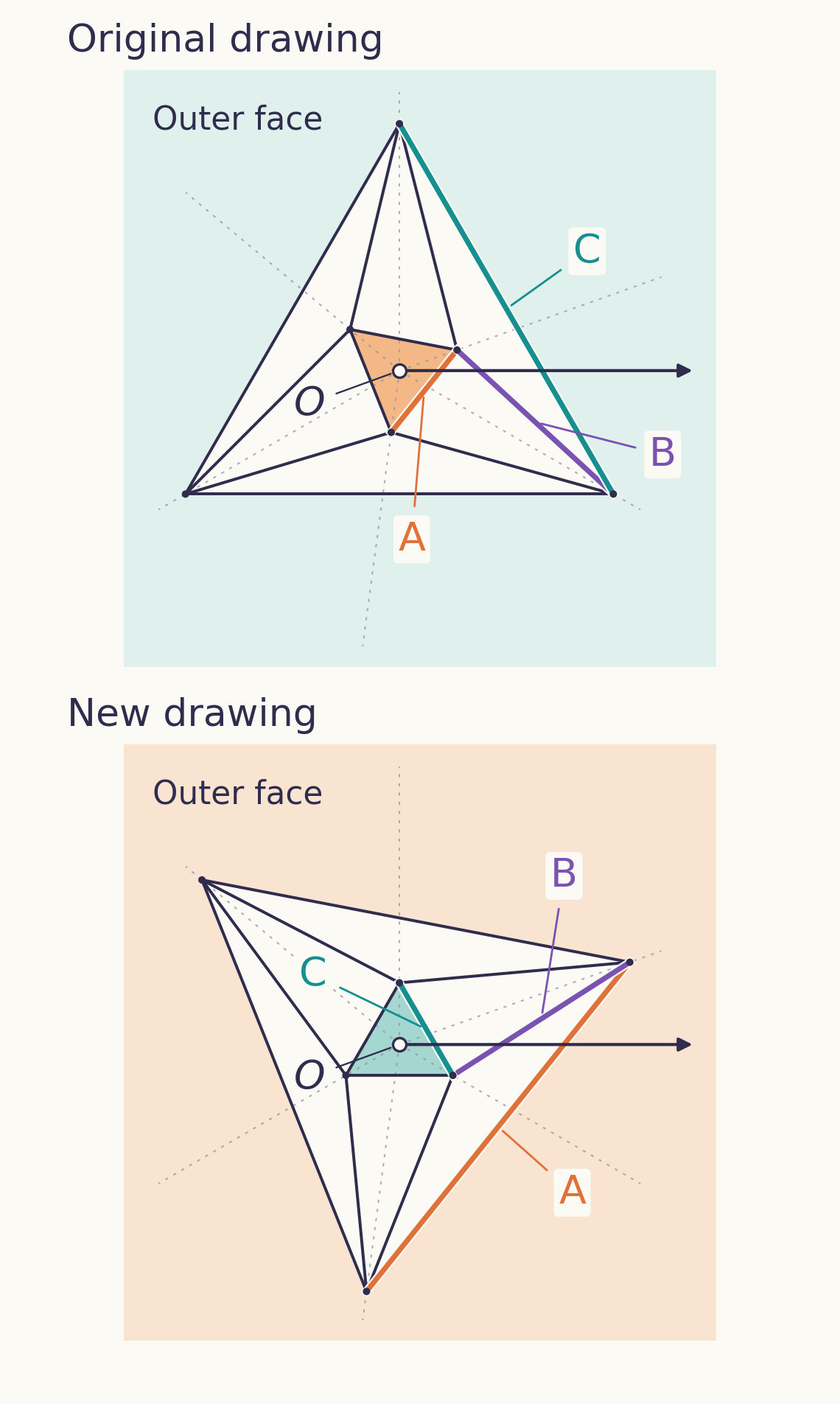
This cannot be achieved simply by turning a sheet of paper over. When a sheet is flipped, nearby parts can remain nearby; here, every route outward from the origin must reverse the original front-to-back relationships.
Jeff Erickson and Birgit Vogtenhuber explicitly posed this question in a report from a 2025 computational geometry seminar. The report already offered an algebraic way to determine whether a particular mesh admits such a drawing, but it still asked: does every mesh satisfying the conditions have a solution? The new paper, Universal Radial Eversion of Planar Triangulations, proves that the answer is yes. Original question, Section 5.3 of the report
Turning a problem of distances into a problem of heights
One tempting approach is to take the reciprocal of each point’s distance from the origin. Faraway points move close, and nearby points move far away, which seems to be exactly what is needed. But ordinary circle inversion turns many straight lines into circular arcs, violating the straight-edge requirement. Inverting only the vertices and then reconnecting them with straight lines does not guarantee a valid mesh either.
To make every local piece meet the requirements, we first need to know exactly what it means for a triangle to “turn over.” Assign an order to its three vertices. Traversing them in that order takes you either clockwise or counterclockwise around the triangle. In the target drawing, this orientation must reverse for every face except the original central face and the original outer face.
A triangle’s orientation can be determined from its signed area. Calculating directly with the distances through which the points move introduces products of different vertices’ scale factors, making the conditions awkward to handle. But if the unknowns are instead the reciprocals of the factors by which the old positions are scaled to obtain the new ones, the orientation conditions become linear inequalities: multiply each unknown by a fixed coefficient, add the results, and require the sum to lie strictly on one side of zero. The algebraic approach to the original question already used this reciprocal representation. The Gewu researcher goes further, asking why the requirements for all the faces can always be satisfied at once.
The key is that these requirements are not independent. Along a ray through a vertex, there is an immediately adjacent face just before reaching the vertex and another just after passing it, with the original central face and outer face at the two ends. Using these before-and-after relationships, the Gewu researcher divides the ordinary triangular faces into two groups and organizes their linear conditions separately.
An identity then ties the entire mesh together. When the geometric coefficients of the faces are combined with particular weights, terms on opposite sides of a shared edge cancel exactly; the remaining terms arranged around a vertex also cancel in succession. This establishes an exact relationship between the two groups of constraints. Using a relationship involving nonnegative coefficients, the paper then constructs a set of values: first, the conditions for one group of ordinary faces are set to zero, while those for the other group already lie on the required side or on the boundary. A final, sufficiently small uniform adjustment pushes the conditions for all ordinary faces strictly onto the required side.
“Strictly” matters. Allowing equality to zero could let some triangles collapse into a line, which would not count as a successful drawing.
There is still a gap that cannot be skipped. Even if every face has the correct orientation, we cannot immediately conclude that the whole mesh has no overlaps. Local orientation describes how each small face is placed; whether two distant faces cover one another is a global question.
To bridge this gap, the Gewu researcher negates the values they have obtained and interprets them as heights in three dimensions: each vertex keeps its horizontal coordinates and gains a vertical coordinate. The values before negation are not yet necessarily all positive, so they cannot yet serve directly as valid reciprocal scale factors for distances. At this stage, each face’s orientation is still controlled by a linear combination of heights. The construction ensures that all faces have their specified orientations and that the three vertices of the original central face lie below the horizontal plane. It does not yet guarantee that the other vertices also lie below it. A sphere will supply this missing global fact.
Why count the two poles?
For now, consider only the mesh’s connections, treating the unbounded outer face as another triangular face that caps the outer boundary. Topologically, the whole mesh is then a sphere. Removing the interior of the original central face leaves something like a disk with a triangular boundary.
Now draw a unit sphere centered at the three-dimensional origin and move the vertices, with their added heights, onto it along directions from its center. Straight edges correspond to minor great-circle arcs on the sphere—the kind followed, for example, by the shortest flight path between two points on Earth. Each triangular face is also mapped to a small triangular region on the sphere.
The algebraic conditions now acquire a geometric meaning: every small face that remains keeps its original sense of traversal on the disk; none is individually reversed. This is called preserving orientation. The removed central face supplies the boundary. Because its three vertices are all below the horizontal plane, the small spherical triangle enclosed by this boundary lies entirely in the southern hemisphere and contains the south pole.
The hoped-for result is that the remaining faces cover this region exactly once. But knowing that the boundary goes around once does not rule out a mesh that covers the inside twice and the outside once: the two sides would still differ by just one layer. Having every small face correctly oriented does not automatically exclude this extra wrapping.
The paper checks for it with a “count.” Choose a point on the sphere that is not on a mesh edge, and count how many small face interiors cover it. In general, a signed count must take positive and negative contributions into account. Here, however, all the small faces have the same orientation, so every covering contributes a positive one, with no cancellation between positive and negative contributions. This count is a concrete instance of the topological concept of the “degree of a map.”
As the observation point moves around on the same side of the boundary loop, the count stays constant. On crossing an internal edge, the boundaries shared by its two adjacent faces cancel, so no extra layer of coverage appears out of nowhere. The count can change only on crossing the boundary of the entire disk. Finding one reliable point inside the loop and one outside is therefore enough to determine the coverage counts in the two regions.
Those two points are the south and north poles.
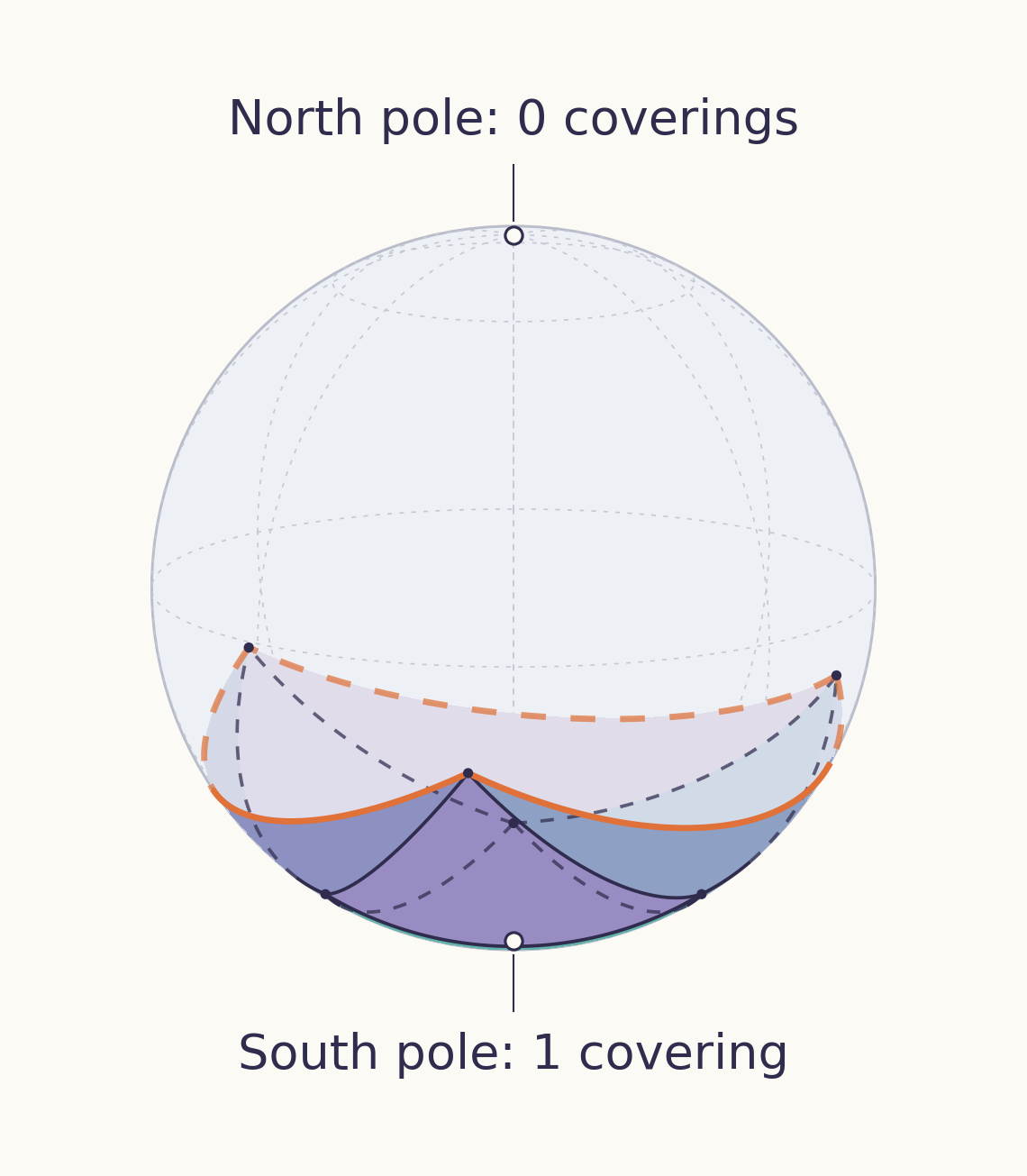
Why are the poles especially easy to count? For a small spherical triangle to cover a pole, its original three vertices in the plane must enclose the origin. Among the faces of the original drawing, only the central triangle and the outer boundary triangle can do this. The former has been removed, leaving only the latter. The sign of its three-dimensional orientation further establishes that it covers the south pole, rather than the north pole, and does so exactly once.
Thus, outside the boundary, the coverage count is zero, just as at the north pole; inside, it is one, just as at the south pole. Since every contribution is positive, the outside cannot hide faces whose contributions cancel, nor can the inside conceal an extra layer.
This count first resolves overlaps between face interiors. To ensure that edges and vertices cause no problems either, the paper also checks the joins: the triangles on either side of a shared edge lie on opposite sides, and if the faces around a vertex were to wrap around an extra time, nearby points would be covered more than once, contradicting the count of one. Only then can the entire disk be confirmed to cover the spherical triangular region in a one-to-one correspondence.
At this point, the global conclusion finally follows: all the vertices are confined to the southern hemisphere, so the heights whose signs had not yet been established must also all lie below the horizontal plane.
Back to the original rays
Project this southern-hemisphere mesh from the sphere’s center onto a horizontal plane below it, and the great-circle arcs become straight line segments again. This central projection is one-to-one within the southern hemisphere, so crossings already excluded on the sphere cannot reappear in the plane.
This operation also explains why the vertex directions are preserved. Set the projection plane at height minus one. Write the original two-dimensional coordinate vector of vertex as , and its constructed vertical height as . Since we have now proved that , its new coordinates are
Here, denotes the vertex’s coordinates in the new drawing. Dividing by a positive number changes only its distance from the origin: it does not rotate its direction or send it to the opposite side of the origin. The original central face becomes the outer face, while the original outer face becomes the face surrounding the origin.
We still need to explain why this reverses the order of all the edges along every ray, rather than merely exchanging inside and outside.
First, which rays encounter an edge depends only on the directions of its endpoints. Moving those endpoints inward or outward along their respective positive rays does not change this set of directions. The same viewing ray therefore encounters the same set of edges, with their original names, in both drawings.
In the original drawing, a ray that avoids all vertices starts in the central face. Each time it crosses an edge, it enters the next adjacent triangular face, eventually reaching the outer face. Because a triangle is convex, a ray cannot leave it and then reenter it, so these faces form a path with no backtracking. In the new drawing, the ray traverses the same set of edges, but starts in the original outer face and ends in the original central face. It follows precisely the reverse of the original path, so the edge order is completely reversed.
If the ray passes exactly through a vertex, several incident edges are encountered simultaneously at the same position, and their relative order has no meaning. The paper combines them into a group and reverses only the order between groups, imposing no order within a group. An argument that slightly rotates the ray and then takes a limit ensures that the theorem includes these special directions too.
One distinction matters: finding two valid drawings does not mean that one can slide continuously into the other in the plane without degeneracy. If a triangle changes continuously from counterclockwise to clockwise, it must pass through a moment when its three vertices are collinear. The eversion in this paper guarantees the existence of the target drawing.
The original question is connected to work on spherical meshes. A sphere has no natural outer face, and understanding how a mesh can be rearranged under constraints such as preserving meridian directions is part of understanding its geometric freedom. Related work by Erickson and Christian Howard studies, among other things, moving spherical meshes along meridians. How to construct continuous morphs of more general spherical meshes efficiently remains a question discussed in the related literature. Answering it requires controlling all intermediate states and the computational cost; a valid endpoint alone is not enough. Related research on spherical meshes
What this proof changes is our understanding of the restriction imposed by fixed directions. For the triangular meshes studied in the paper, directions confine each vertex to a ray, but they do not fix which face must stay on the outside. Along every ray, the front-to-back order can be reversed in another crossing-free, straight-edged drawing. What makes this coordination possible is the algebraic relationship between the faces, together with the global constraint that the entire mesh covers its region only once.
Research basis: Universal Radial Eversion of Planar Triangulations, particularly Theorem 1.3, Proposition 2.2, and Lemma 2.3. The supplied version is labeled as an anonymous submission; this article makes no further inference about its publication or review status. The illustrations are original, programmatically drawn artwork by the author. The figures in the body of the article are illustrative constructions, not experimental data.