
Scientists / Open questions
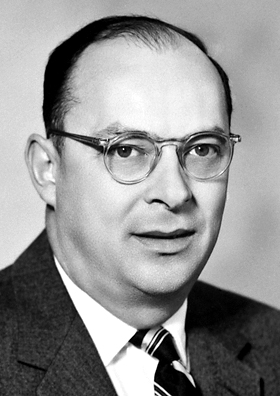
John Bardeen
Semiconductor physics; superconductivity
1956, 1972 Nobel Prize in Physics
18 questions
Pairing mechanism of high-temperature superconductivity in the cuprates: the origin of the pairing interaction and the sufficiency of BCS-type pairing theory (from Bardeen's 1987 open questions)
Surface states and the barrier height at metal–semiconductor contacts: the open questions of Bardeen (1947) and their surviving core
Realizing the exciton mechanism of superconductivity: virtual-exciton-mediated pairing at metal-semiconductor interfaces (Allender-Bray-Bardeen model)
Genuine Fröhlich superconductivity in real quasi-one-dimensional conductors: the open question arising from Bardeen's 1973 account of superconducting fluctuations in one-dimensional organic solids
Beyond the local Bardeen–Stephen model: the microscopic, nonlocal theory of vortex motion in type-II superconductors in the clean, low-temperature, low-field regime, and the experimental verification of its distinctive predictions
Josephson current in clean ballistic superconductor-normal-superconductor junctions: the continuum (scattering-state) contribution beyond bound-state dominance and its cancellation structure
Microscopic origin of subthreshold ac-dc decoupling and photon-assisted-tunneling scaling in charge-density-wave conductors (NbSe3)
Charge-density-wave depinning in NbSe3: the pinning frequency and impurity dependence from the frequency-dependent conductivity, and the threshold field and effective charge near the Peierls transition (Bardeen's 1979 open questions)
Quantitative incorporation of Coulomb interactions and screening dynamics in the tunneling theory of charge-density-wave depinning
Microscopic mechanism of sliding charge-density-wave transport: pinning persistence, Zener-like high-field conductance, and complete mode locking in quasi-one-dimensional conductors
Microscopic foundation and experimental test of quantum-tunneling depinning of charge-density waves
Universal threshold polarization for charge-density-wave depinning: testing across compounds and deriving its dimensionality, Coulomb, and relaxation corrections
Microscopic theory of charge-density-wave conduction under combined ac and dc fields in NbSe3: quantum tunneling versus classical depinning of the collective phase
Unresolved issues in the quantum-tunneling theory of charge-density-wave depinning: sliding mechanism, below-threshold response, and coupling to narrow-band noise
Quantum tunneling theory of charge-density-wave depinning: the Coulomb-dominated low-temperature regime, microscopic thermal activation, coherence time, and electron-condensate momentum transfer
Microscopic interpretation of charge-density-wave current oscillations in NbSe: effective transport period and pinning-barrier mechanism
Validity and microscopic basis of the tunneling theory of charge-density-wave depinning: correlation length, universal tunneling function, effective collective charge, and photon-assisted frequency response
Completing the microscopic quantum-tunneling theory of charge-density-wave depinning: polarization fields, disordered metastable domains, and relaxation dynamics near threshold